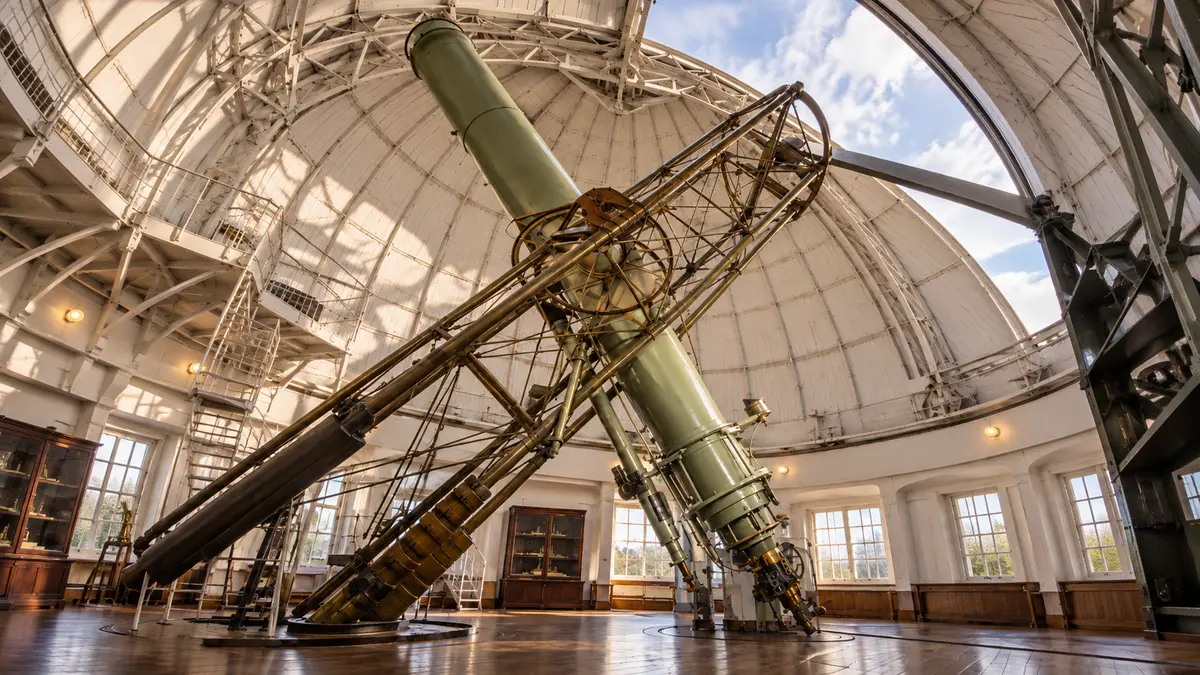
Erected in 1893, the Great Equatorial Telescope represents the apex of 19th-century optical craftsmanship. Commissioned by the eighth Astronomer Royal, Sir William Christie, the instrument was conceived to replace an earlier 12.75-inch telescope and elevate Greenwich's observing power into the modern astrophysical era. The massive 28-foot iron barrel houses a 28-inch doublet lens fashioned by Sir Howard Grubb of Dublin, renowned for producing some of the finest astronomical glass of the Victorian period.
To accommodate this gargantuan apparatus, the observatory constructed a distinctive 'onion' dome made of iron framework and papier-mâché pulp covering known as fibropus, which reduced structural weight while protecting the delicate optics from condensation. Though modern professional research has migrated to high-altitude and space-based platforms, this magnificent green refractor remains fully operational, functioning as both an active educational instrument and a breathtaking testament to human curiosity.
Reasons to Visit
- Witness the largest refracting telescope in the UK and the seventh largest optical refractor ever constructed worldwide.
- Admire the unique architectural design of the Victorian onion dome constructed from revolutionary 19th-century lightweight materials.
- Explore intricate brass gears, counterweights, and the original mechanical clockwork drive that compensated for Earth's rotation.
- Capture striking architectural and industrial photography of Victorian scientific design set against Greenwich Park.
Things to Avoid
- Avoid bringing bulky luggage or large strollers up to the dome, as the spiral staircases and walkways are narrow.
- Do not touch the delicate brass gearing, counterbalances, or optical mountings, as oils from skin degrade the historic finishes.
- Avoid visiting during midday on summer weekends if you wish to photograph the instrument without crowds in your frame.
- Do not skip the lower galleries, which contain fascinating archival notes and historical astrophotography records.
Local Transportation Tips
The Great Equatorial Telescope is located inside the Royal Observatory at the summit of Greenwich Park. The most scenic transit route is via the Docklands Light Railway (DLR) to Cutty Sark for Maritime Greenwich, followed by a 12-minute walk uphill through the park. Alternatively, take Southeastern rail to Greenwich or Maze Hill stations, or board the Uber Boat by Thames Clippers to Greenwich Pier for an unforgettable river approach.
Travel Etiquette
- Maintain a quiet, respectful tone inside the dome to preserve the reflective atmosphere of the observatory.
- Step aside along the narrow viewing gantry to allow fellow visitors to circulate comfortably around the base of the telescope.
- Turn off flash photography inside the dome to prevent glare and protect historic display materials.
- Yield right-of-way to visitors descending the steep historic stairs before beginning your ascent.
Recommended Age Group
The Great Equatorial Telescope offers an inspiring encounter with science and history, though access requires navigating historic steps.
- Babies (0-2 years): Not Recommended. The upper dome is accessible only via narrow, steep stairs where strollers are prohibited, making babywearing mandatory and maneuvering awkward.
- Kids (3-12 years): Recommended. Children are consistently captivated by the massive scale of the green telescope and the mechanical novelty of the onion dome.
- Teens (13-19 years): Recommended. Science students and photography enthusiasts will appreciate the complex engineering and photogenic industrial aesthetics.
- Adults (20-64 years): Recommended. A premier cultural attraction offering rich insights into Victorian science, engineering history, and London heritage.
- Seniors (65+ years): Recommended. Highly rewarding for history and science admirers, provided visitors can manage moderate flights of stairs.
Accessibility Level: Medium
- Access to the upper dome housing the Great Equatorial Telescope is via historic stairs, which means it is unfortunately not wheelchair accessible.
- The ground level of the Royal Observatory, including the courtyard, Prime Meridian line, and modern Astronomy Centre, provides level step-free access and accessible restrooms.
- Assistance dogs are warmly welcomed throughout all areas of the Royal Observatory complex.
- Large-print guides and tactile descriptive resources are available upon request at the visitor reception desk.
Did You Know?
During the London Blitz in World War II, the valuable 28-inch doublet lens was removed from the telescope barrel and evacuated to a secure countryside vault in Gloucestershire, successfully preserving it from the bomb damage that struck Greenwich Park.
Cool Statistics
- 28 inches: Clear aperture diameter of the Grubb objective lens.
- 28 feet: Total focal length of the telescope's massive green tube assembly.
- 1893: The year the instrument was commissioned and saw its first celestial light.
- 7th: Rank among the largest refracting telescopes ever built in human history.






Buy a compatible power adapter for your trip