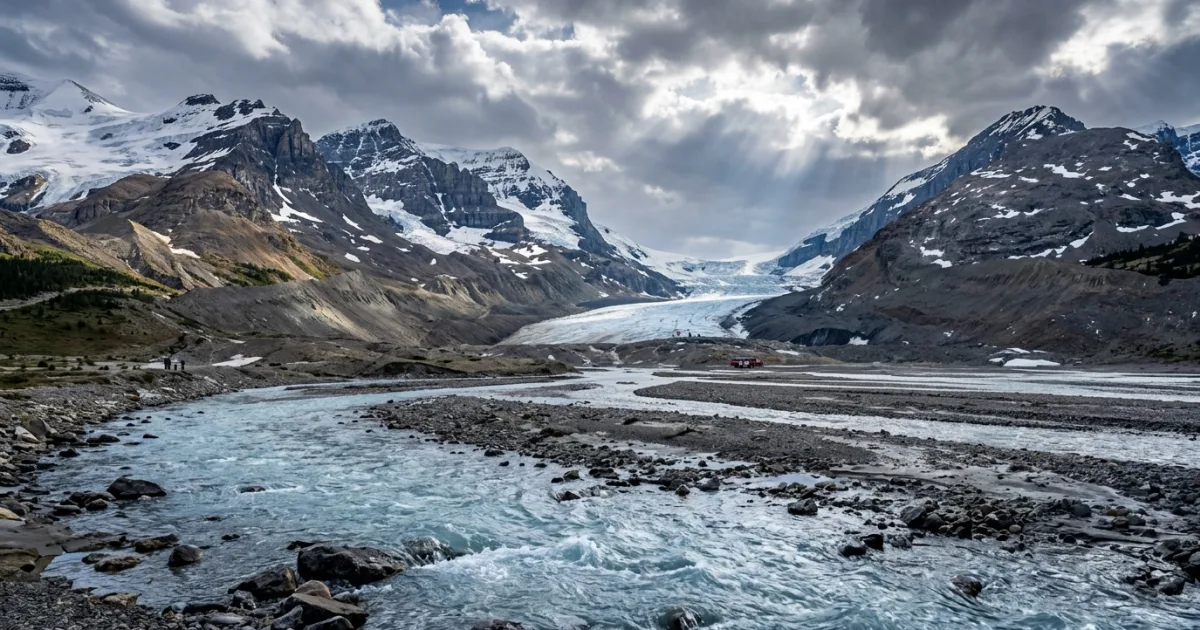
The Columbia Icefield is one of the most accessible and scientifically monitored ice sheets in the world. Straddling the Continental Divide between Jasper and Banff National Parks, it feeds massive glaciers, subalpine river networks, and delicate ecosystems across western Canada. Its history spans thousands of years of geological formation, representing a crucial barometer for global climate study.
Today, visitors can experience the raw power of the ice through guided excursions on the Athabasca Glacier or take in dramatic aerial perspectives from the glass-bottomed Columbia Icefield Skywalk hanging 280 meters over the Sunwapta Canyon. Located roughly midway along the world-famous Icefields Parkway, it stands as a natural highlight of any road trip through the Canadian Rocky Mountains.
Reasons to Visit
- Walk upon the surface of an ancient glacier formed thousands of years ago.
- Experience a ride on the iconic, massive Ice Explorer all-terrain vehicles.
- Step out over the Sunwapta Valley on the thrilling, glass-floored Columbia Icefield Skywalk.
- Observe firsthand the physical effects and historical markers of glacial recession.
- Drive along the Icefields Parkway, consistently ranked among the world's top scenic drives.
Things to Avoid
- Never walk past the safety warning ropes onto the unguided glacier ice due to hidden crevasses.
- Avoid wearing sandals, slick footwear, or lightweight clothing on the ice.
- Do not rely on mobile data or streaming maps, as connectivity drops for dozens of kilometers along Highway 93.
- Avoid planning your visit between November and April if you wish to do commercial tours, as facilities are completely shut.
Local Transportation Tips
There is no public transit running directly to the Columbia Icefield. Visitors must drive their own vehicle, hire a rental car from Calgary or Edmonton, or book a commercial sightseeing coach tour departing from Jasper, Banff, or Lake Louise. During peak season, ample outdoor parking is available at the Glacier Discovery Centre for passenger vehicles and recreational vehicles (RVs).
Travel Etiquette
- Stay on designated footpaths and marked viewing decks to preserve sensitive alpine tundra.
- Never litter or discard waste; follow strict Leave No Trace principles throughout the national park.
- Keep a safe distance of at least 30 meters from elk, bighorn sheep, and deer, and 100 meters from bears.
- Yield to descending hikers and tour vehicles on narrow pathway corridors.
Recommended Age Group
Visiting the Columbia Icefield is an incredible experience for all ages, though cold temperatures and steep boarding steps require minor preparation for specific travelers.
- Babies (0-2 years): Neutral. Cold wind gusts and bumpy bus rides can be harsh for young infants; baby carriers are necessary as strollers cannot navigate the glacier ice.
- Kids (3-12 years): Recommended. Children are fascinated by the enormous Ice Explorer monster trucks and walking directly on glacial ice.
- Teens (13-19 years): Recommended. High scenic engagement, thrilling glass skywalk, and prime photography opportunities for social media.
- Adults (20-64 years): Recommended. Exceptional hiking, photography, and geological exploration across diverse mountain trails.
- Seniors (65+ years): Recommended. Accessible vehicle tours and gentle observation platforms make experiencing the glacier straightforward without strenuous climbing.
Accessibility Level: Accessible Accommodations
- The Glacier Discovery Centre features ramped access, automatic entrance doors, accessible washrooms, and elevator service between floors.
- Select Ice Explorer vehicles are equipped with wheelchair lifts; advance reservation is required with Pursuit Collection.
- The Columbia Icefield Skywalk is completely barrier-free with flat, glass-paneled surfaces and gentle grades suitable for wheelchairs and walkers.
- Designated accessible parking spaces are situated directly adjacent to the main visitor center entrance.
Did You Know?
The Columbia Icefield serves as a triple continental divide; its melting water flows outward into three different oceans: the Pacific Ocean, the Arctic Ocean, and the Atlantic Ocean (via Hudson Bay).
Cool Statistics
- Area: Approximately 230 square kilometers (89 square miles).
- Maximum Ice Thickness: Up to 365 meters (1,200 feet) deep.
- Highest Peak: Mount Columbia at 3,747 meters (12,293 feet) above sea level.
- Annual Snowfall: Receives up to 7 meters (23 feet) of fresh snow each year.






Buy a compatible power adapter for your trip