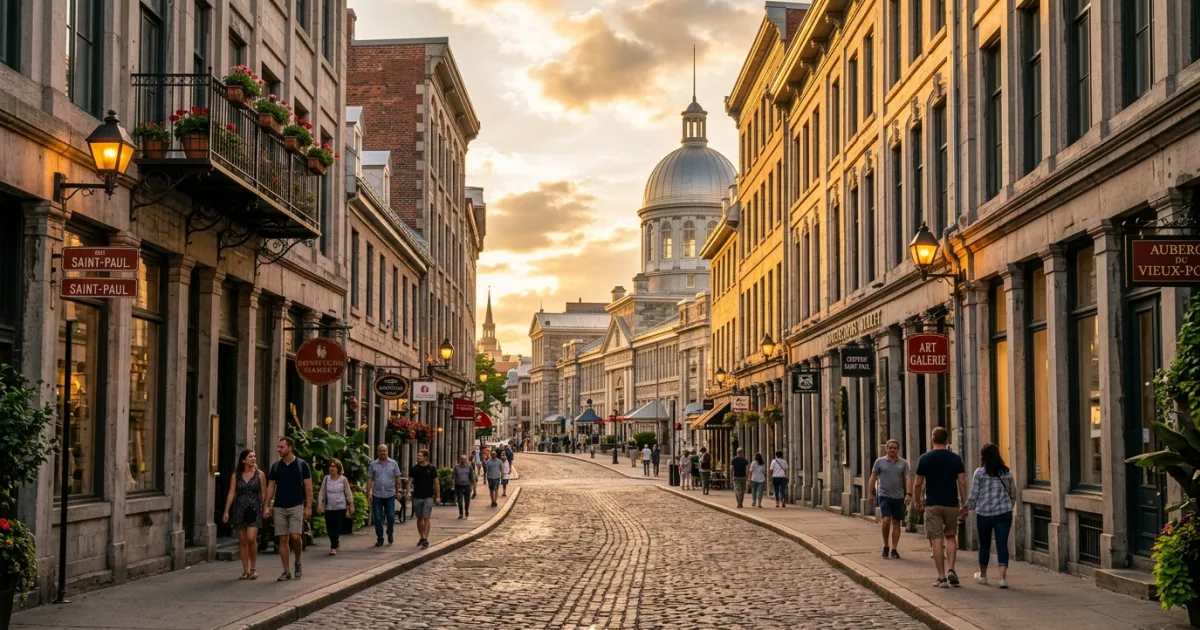
Old Montreal is the foundational historic sector of Canada's second-largest metropolis, situated directly along the Saint Lawrence River. Established in 1642 as Ville-Marie, the neighborhood contains the highest concentration of 17th, 18th, and 19th-century architecture in North America outside of Quebec City. The district's urban grid unfolds across narrow stone alleyways, wide neoclassical banking streets, and bustling public squares like Place Jacques-Cartier and Place d'Armes.
Today, Old Montreal operates as a vibrant mixed-use enclave where historical conservation coexists with high fashion, boutique hospitality, and gastronomy. Directly bordering the district is the Old Port (Vieux-Port), a 2-kilometer linear waterfront park that provides access to the Montreal Science Centre, river cruise docks, and sprawling promenades that look out toward Saint Helen's Island and Habitat 67.
Reasons to Visit
- Unmatched Architectural Heritage: Experience the largest cluster of preserved French and British colonial architecture in North America.
- Notre-Dame Basilica of Montreal: Marvel at deep blue-and-gold Gothic Revival woodwork and the acclaimed AURA light spectacle.
- World-Class Gastronomy: Dine on exceptional French-Canadian cuisine, wood-fired bagels, and local charcuterie in atmospheric stone-walled rooms.
- Scenic Riverfront Access: Walk, cycle, or take a river excursion along the sprawling Old Port recreational park.
- Underground History: Explore real 17th-century foundations and the city's original collector sewer inside the Pointe-à-Callière Museum.
Things to Avoid
- Avoid wearing thin-soled shoes, high heels, or flip-flops, as the uneven historic cobblestone surfaces can easily cause twisted ankles.
- Do not drive a personal vehicle into Old Montreal during summer weekends; parking is scarce, streets are narrow, and many sections are pedestrianized.
- Avoid eating exclusively on the main terrace strip of Place Jacques-Cartier; venture one or two blocks onto Saint-Paul, Saint-Pierre, or Notre-Dame for higher quality food at lower prices.
- Do not skip booking Notre-Dame Basilica entry tickets well in advance to avoid long queue times.
Local Transportation Tips
Old Montreal is exceptionally well connected via public transit and is best navigated on foot. The Orange Line of the Montreal Metro serves the northern boundary of the district via the Place-d'Armes and Champ-de-Mars stations. From either station, the historic heart is less than a five-minute walk downhill. BIXI bike-share stations are situated across the waterfront and along key avenues, offering an efficient way to pedal along the Lachine Canal bike path or the Old Port promenade.
Travel Etiquette
- Greeting: Greet shopkeepers and hospitality staff with a pleasant 'Bonjour' when entering an establishment; it is considered polite before transitioning into English if needed.
- Tipping: Standard restaurant and bar tipping in Montreal is 15% to 20% on the pre-tax bill. Tip prompts on card machines calculate percentages after tax, so check closely.
- Pedestrian Etiquette: Step aside to allow oncoming pedestrian traffic to pass when stopping to take photos on narrow sidewalks.
- Quiet in Sacred Spaces: Maintain a hushed voice and dress respectfully inside Notre-Dame Basilica and Notre-Dame-de-Bon-Secours Chapel.
Recommended Age Group
Old Montreal accommodates a wide demographic spectrum, though its historic physical features require realistic expectations regarding mobility.
- Babies (0-2 years): Neutral. The cobblestone streets and older buildings without elevators make navigating with bulky strollers challenging, though baby carriers work well.
- Kids (3-12 years): Recommended. Children enjoy the Montreal Science Centre, pirate ship ropes courses at the Old Port, horse-drawn carriage views, and seasonal zip lines.
- Teens (13-19 years): Recommended. Great boutique shopping, independent cafes, social-media photo spots, and the La Grande Roue observation wheel provide plenty of appeal.
- Adults (20-64 years): Recommended. Perfect for romantic getaways, heritage walks, cocktail lounges, world-class dining, and museum visits.
- Seniors (65+ years): Recommended. The flat riverfront terrain, guided historic tours, and rich cultural sites are ideal, though care must be taken on uneven cobblestone street crossings.
Accessibility Level: Medium
- Cobblestone Surfaces: Many streets, notably Rue Saint-Paul, feature historic cobblestones and raised granite curbs which present vibration and navigation hurdles for manual wheelchairs and mobility scooters.
- Historic Building Entrances: Due to heritage status, numerous boutiques and bistros retain single-step entries without exterior ramps; however, prominent museums (Pointe-à-Callière, Montreal Science Centre) are fully barrier-free with elevator access.
- Transit Accessibility: The nearby Champ-de-Mars metro station features elevator access, making it the most wheelchair-accessible transit gateway into Old Montreal.
- Old Port Promenade: The 2-kilometer riverfront promenade is wide, paved, and flat, offering barrier-free access to waterfront viewpoints, restaurants, and piers.
Did You Know?
Pointe-à-Callière Museum is built directly over Montreal's archaeological birthplace. Visitors walk through excavated 17th-century stone structures and step onto a footbridge suspended inside North America's first vaulted stone collector sewer, engineered between 1832 and 1838.
Cool Statistics
- Old Montreal spans roughly 1 square kilometer of protected historic area.
- The neighborhood contains buildings dating back to 1685, including the Old Saint-Sulpice Seminary.
- Notre-Dame Basilica's soaring ceiling contains thousands of 24-karat gold leaf stars set against an azure backdrop.
- Over 6 million visitors explore the Old Port of Montreal each year.







Buy a compatible power adapter for your trip