Everglades National Park safeguards an internationally renowned wetland that spans southern Florida's limestone shelf. Far from an idle swamp, the Everglades is a massive, slow-flowing freshwater river roughly 60 miles wide and only inches deep, moving imperceptibly south from Lake Okeechobee toward Florida Bay. This complex hydrologic system encompasses distinct habitats, including sawgrass prairies, hardwood hammocks, pinelands, and the largest continuous mangrove forest in the western hemisphere.
Because human development altered historical water flow throughout the twentieth century, the park remains the focal point of the largest ecological restoration project in American history. For travelers, it presents an unparalleled open-air classroom where one can witness alligators and crocodiles coexisting in the same waters, encounter endangered wood storks feeding in shallow marshes, and explore pristine sub-tropical wilderness just an hour's drive from Miami's metropolitan core.
Reasons to Visit
- Witness the only ecosystem in the world where both American alligators and American crocodiles live together side-by-side.
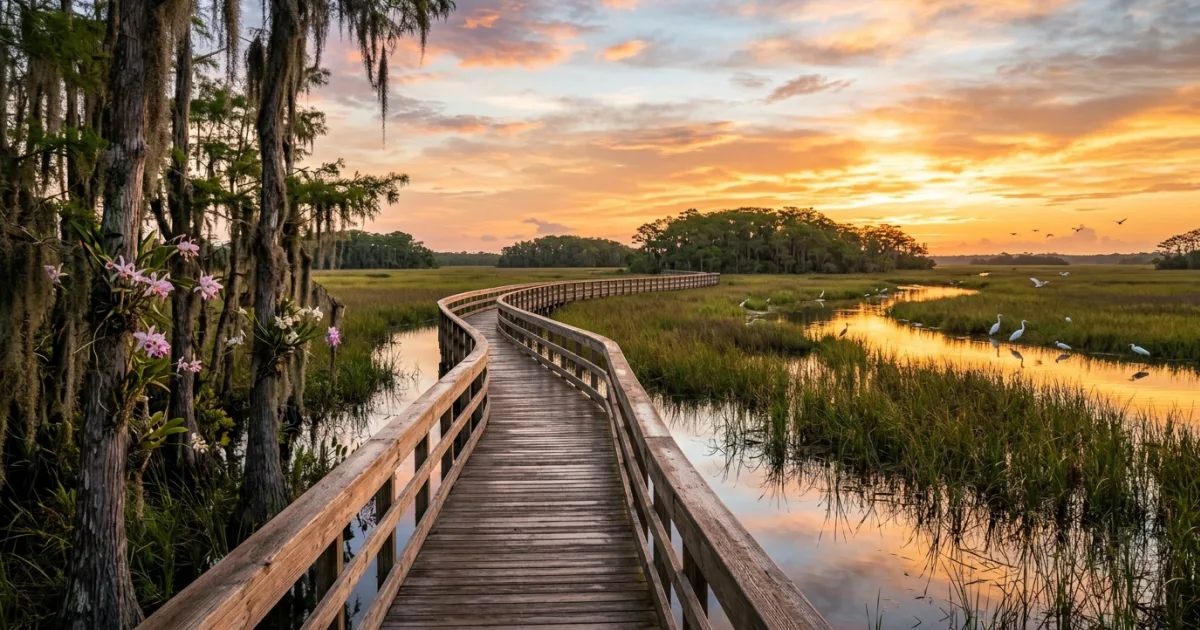
- Walk the elevated Anhinga Trail boardwalk for high-density, eye-level views of predatory birds, turtles, and alligators.
- Cycle the flat 15-mile Shark Valley loop leading to a panoramic 65-foot observation tower.
- Paddle through the labyrinthine mangrove waterways of the Ten Thousand Islands along the park's western Gulf coast.
- Experience designated International Dark Sky stargazing over the untouched open expanses of Flamingo and Mahogany Hammock.
Things to Avoid
- Avoid entering the park during summer without heavy-duty insect repellent, head nets, and protective long clothing.
- Do not approach or feed wildlife of any kind, which is strictly illegal and disrupts their natural foraging behaviors.
- Never leave open food or bait in open vehicle beds, as black vultures will tear into rubber window seals and raid food containers.
- Do not stray from marked trails into sawgrass prairies; the jagged sawgrass blades can cause deep skin cuts, and deep sinkholes are hidden under the water.
- Avoid assuming GPS navigation is reliable across remote park roads; always download offline maps before entering.
Local Transportation Tips
A personal car or rental vehicle is essential for visiting Everglades National Park, as public transit does not run into the park boundaries. Highway 41 (Tamiami Trail) accesses the Shark Valley visitor center and Gulf Coast operations, while Florida State Road 9336 connects Homestead to the Ernest F. Coe Visitor Center and Flamingo. Inside the park, human-powered transport rules: Shark Valley provides bicycle rentals alongside a two-hour guided tram tour, and Flamingo rents kayaks, canoes, and small skiffs for maritime navigation.
Travel Etiquette
- Yield the right-of-way to wildlife on paved walking loops and tram paths, remaining stationary until they cross.
- Practice Leave No Trace principles by packing out every piece of trash, including fruit rinds and food packaging.
- Keep noise levels down while paddling or walking trails to avoid startling roosting wading birds.
- Drones are completely banned in all areas of Everglades National Park to protect nesting avian populations.
Recommended Age Group
Everglades National Park offers unique encounters with pristine wilderness, though conditions vary widely based on physical endurance and tolerance for the elements.
- Babies (0-2 years): Not Recommended. Intense heat, aggressive sun exposure, and heavy mosquito populations make outdoor exploration uncomfortable and hazardous for infants.
- Kids (3-12 years): Recommended. Junior Ranger activity booklets, up-close alligator sightings from safe railed boardwalks, and open-air tram rides make the park highly educational and thrilling for young children.
- Teens (13-19 years): Recommended. Ideal for active teens who enjoy off-grid kayaking, wilderness camping on chickee platforms, and long-distance cycling.
- Adults (20-64 years): Recommended. Outstanding opportunities for photography, nature hiking, birdwatching, and back-country paddling.
- Seniors (65+ years): Recommended. Flat, barrier-free boardwalks, guided tram tours at Shark Valley, and boat excursions from Flamingo provide comfortable wildlife access without strenuous hiking.
Accessibility Level: Medium
- The iconic Anhinga Trail, Gumbo Limbo Trail, and Mahogany Hammock Trail are fully paved or elevated boardwalks with handrails, making them easily wheelchair accessible.
- The Shark Valley Tram Tour provides ADA-accessible open-air trams equipped with motorized wheelchair lifts (advance reservation recommended).
- The Ernest F. Coe, Shark Valley, and Flamingo Visitor Centers feature level access, accessible restrooms, and designated accessible parking stalls.
- Wheelchairs are available for loan free of charge on a first-come, first-served basis at major visitor centers.
Did You Know?
Everglades National Park is the only place on planet Earth where alligators and crocodiles coexist naturally in the wild. Alligators prefer the freshwater sawgrass sloughs, while American crocodiles thrive in the brackish coastal mangroves and saltwater bays of Flamingo.
Cool Statistics
- 1.5 million acres of protected wilderness, making it the third-largest national park in the contiguous United States.
- Over 360 recorded species of birds reside in or migrate through the Everglades annually.
- Home to the largest continuous stand of protected mangrove forest in the Western Hemisphere.
- Water flows across the river of grass at an average pace of just 100 feet per day.









Buy a compatible power adapter for your trip