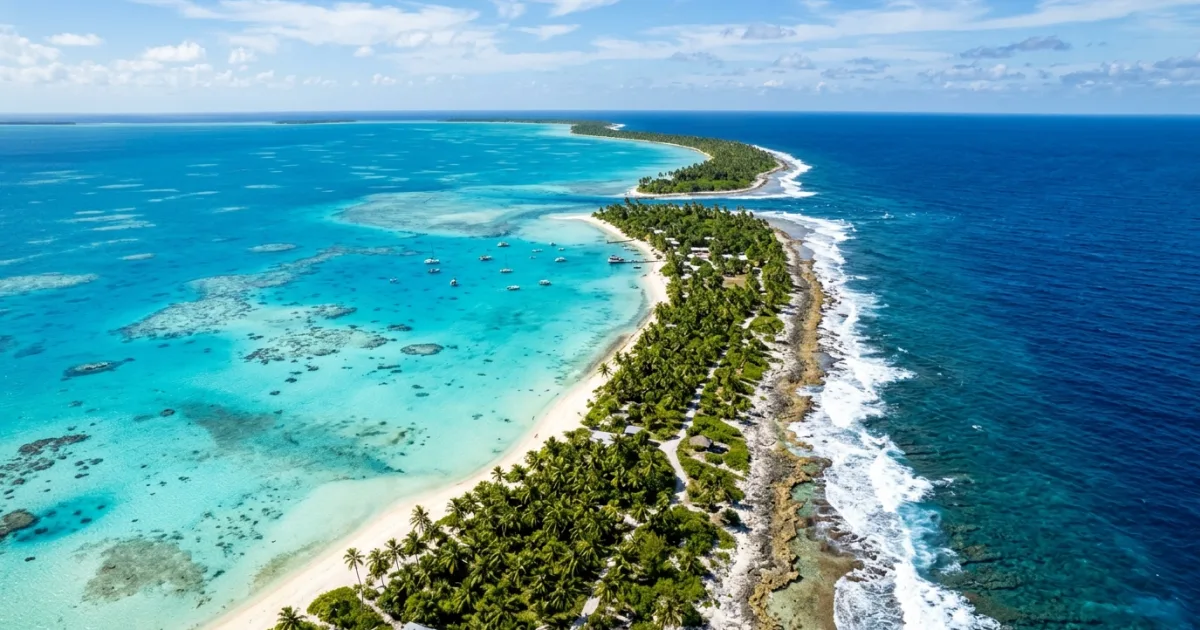
Rangiroa, meaning 'Vast Sky' in the local Paumotu language, is a natural masterpiece consisting of approximately 415 islands and islets known as motus. The atoll's land surface encompasses barely 170 square kilometers, yet its inner lagoon spans over 1,600 square kilometers, functioning essentially as an enclosed inland ocean. Connected to the open South Pacific via two deep passages—Avatoru Pass and Tiputa Pass—Rangiroa experiences massive tidal surges twice daily that generate exceptional marine spectacles.
Life on the main rim centers along a slender, single paved roadway stretching ten kilometers between Avatoru and Ohotu wharf. Travelers come here primarily for raw natural wonder rather than manicured urban luxury: local pearl farms demonstrate the delicate extraction of Tahitian black pearls, coral wineries harvest unusual vintages on distant motus, and sunsets at Tiputa Pass regularly showcase pods of wild spinner and bottlenose dolphins jumping in the outbound ocean swell.
Reasons to Visit
- World-class scuba diving featuring drift encounters with gray reef sharks, dolphins, and manta rays.
- Day excursions to the surreal Blue Lagoon (Lagon Bleu), a shallow lagoon within a lagoon ringed by tiny white-sand motus.
- Unique wine tasting experiences at Domaine Dominique Auroy, one of the world's few coral-atoll vineyards.
- Uncrowded, pristine beaches featuring faint pink-tinted sands at Sables Roses.
- Authentic cultural immersion in tranquil Paumotu villages with minimal commercial tourism footprint.
Things to Avoid
- Do not swim or kayak through the Avatoru or Tiputa passes without a licensed maritime operator due to lethal current speeds.
- Avoid touching or stepping on coral reefs, both for fragile marine habitat preservation and to prevent severe coral cuts.
- Do not rely entirely on credit cards or debit cards; carry sufficient cash for transfers, snacks, and village pensions.
- Avoid planning tight flight connections on departure days, as inter-island flight schedules can change based on weather.
Local Transportation Tips
Transit on Rangiroa is straightforward given the atoll's narrow geography. The main inhabited strip between the airport, Avatoru, and Ohotu wharf is served by a single flat, paved road. Most pensions and hotels offer complimentary or low-cost bicycle rentals, which is the most practical and popular way to get around. Small car and electric scooter rentals are also available near the airport. Crossing between the Avatoru side and the village of Tiputa requires taking the local water taxi, which runs continuous daytime shuttles across Tiputa Pass for a small cash fare.
Travel Etiquette
- Remove your shoes or sandals before entering local family pensions, homes, and traditional dining verandas.
- Always greet locals with a polite 'Ia Orana' or 'Bonjour' when passing on village roads.
- Dress modestly with cover-ups or shirts when walking through the residential streets of Avatoru and Tiputa.
- Seek permission prior to photographing local residents, fishermen, or children at play.
Recommended Age Group
Rangiroa's activity profile is dominated by water sports, boat transfers, and remote outdoor recreation.
- Babies (0-2 years): Not Recommended. The remote setting, intense equatorial sun, limited medical facilities, and rough open boat rides are challenging for infants.
- Kids (3-12 years): Neutral. Children confident in open water can enjoy snorkeling the shallow motus, but activities are specialized and lack structured family attractions.
- Teens (13-19 years): Recommended. Excellent destination for adventurous teenagers keen on certified scuba diving, snorkeling with sharks, and water sports.
- Adults (20-64 years): Recommended. Ideal demographic for underwater exploration, relaxation, drift diving, and remote island nature retreats.
- Seniors (65+ years): Neutral. Enjoyable for active seniors interested in relaxed nature and marine scenery, though boarding small speedboats from wet landings demands mobility.
Accessibility Level: Medium
- The flat topography of the main paved roadway permits manageable mobility along the central strip.
- Most dive boats and excursion vessels are small runabouts requiring steps over gunwales and wet landings on sand.
- Accommodations are predominantly traditional bungalows, often featuring coral gravel pathways and wooden thresholds without ramp access.
- Medical infrastructure is limited to an atoll infirmary; severe medical emergencies necessitate air evacuation to Tahiti.
Did You Know?
Rangiroa's vast lagoon is so immense that it has its own internal horizon; if you stand on one side of the atoll, the landmass on the opposite side is completely hidden beneath the curve of the Earth.
Cool Statistics
- 1,640 km²: The surface area of Rangiroa's inner lagoon, large enough to submerge the entire island of Tahiti.
- 2: The number of navigable passes (Avatoru and Tiputa) connecting the South Pacific Ocean to the lagoon.
- Around 2,500: The permanent human population residing across the entire atoll.






Buy a compatible power adapter for your trip