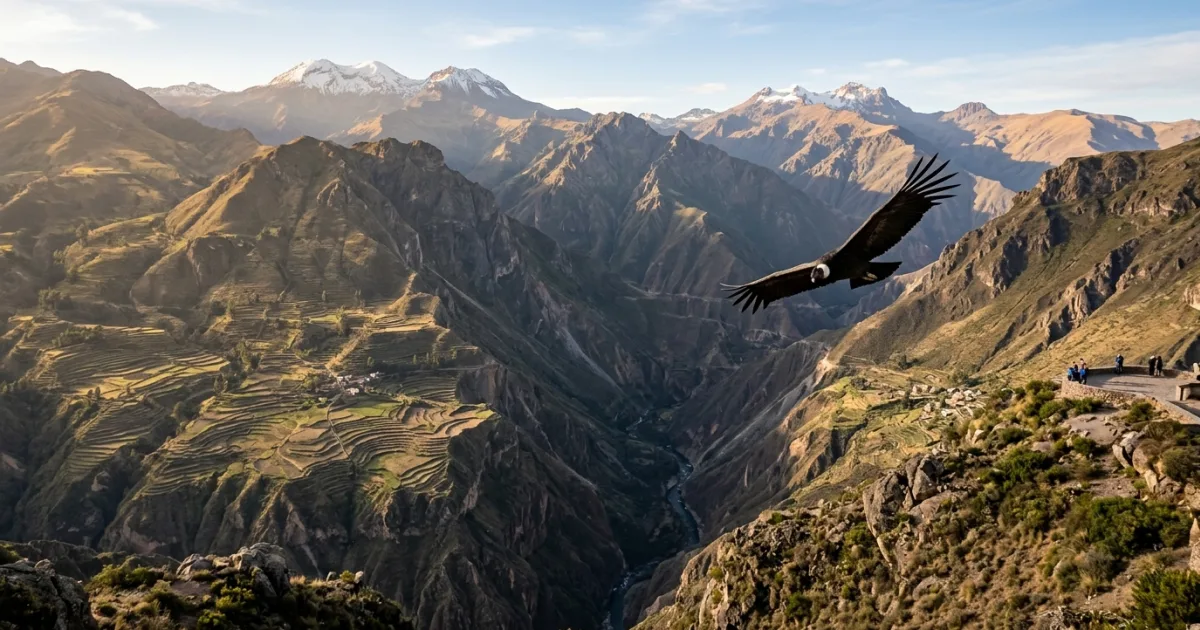
Caylloma Province is an extraordinary highland territory in the Peruvian Andes, celebrated worldwide for containing the Colca Canyon, which plunges more than twice the depth of the Grand Canyon. Ancient pre-Inca cultures, primarily the Collagua and Cabana peoples, transformed the vertical slopes of the valley into an elaborate network of agricultural terraces (andenes) that remain productive today. Colonial architecture dots the province, featuring white sillar stone churches built during the 16th and 17th centuries in villages like Lari, Yanque, and Coporaque.
The region offers a profound balance between untamed biodiversity and tranquil rural life. Herds of vicuñas and alpacas roam the Salinas y Aguada Blanca National Reserve on the approach to Chivay, while thermal mineral springs provide natural relaxation after demanding hikes. With dramatic geologic vistas framing smoking stratovolcanoes like Sabancaya, Caylloma remains one of South America's most captivating high-altitude travel frontiers.
Reasons to Visit
- Marvel at the majestic flight of the Andean condor up close from the Cruz del Cóndor viewpoint.
- Trek down into the depths of the Colca Canyon and unwind in the palm-fringed oasis of Sangalle.
- Soak in natural thermal hot springs surrounded by mountain scenery at La Calera and Chacapi.
- Witness the living culture and hand-embroidered textiles of the indigenous Collagua and Cabana communities.
- Traverse dramatic volcanic landscapes, including the 4,910-meter Patapampa viewpoint overlooking active volcanoes.
Things to Avoid
- Do not attempt strenuous hiking immediately upon arrival; allow at least 24 hours to acclimatize to high elevations.
- Avoid hiking down into the canyon without ample drinking water and a reliable sun hat, as canyon valley temperatures climb rapidly by midday.
- Do not photograph local villagers in traditional dress without politely asking permission first.
- Avoid drinking tap water anywhere in the province; consume bottled or boiled water exclusively.
Local Transportation Tips
Travel across Caylloma Province relies primarily on local buses and shared minivans known as collectivos connecting Chivay with outlying villages such as Yanque, Maca, and Cabanaconde. Roads along the canyon rim are generally paved between Chivay and Cruz del Cóndor, but unpaved secondary routes can become bumpy and slow. For flexibility and convenience, many travelers book shared tourist transport from Arequipa or hire private 4x4 drivers for multi-day itineraries.
Travel Etiquette
- Always greet locals with a respectful 'Buenos días' or 'Buenas tardes' when entering rural villages and shops.
- Respect religious customs inside colonial churches by removing hats and refraining from flash photography during services.
- Tip trekking guides and muleteers generously, as canyon guiding requires strenuous physical effort under demanding conditions.
Recommended Age Group
Caylloma Province is an intense high-altitude landscape best suited for travelers capable of handling steep terrain and reduced oxygen levels.
- Babies (0-2 years): Not Recommended. Extreme elevation (exceeding 3,600m) and limited pediatric healthcare make this destination risky for infants.
- Kids (3-12 years): Neutral. Children may enjoy condor watching and hot springs, but long winding van rides and altitude symptoms require caution.
- Teens (13-19 years): Recommended. Ideal for active adolescents who enjoy rigorous trekking, canyon landscapes, and adventure sports.
- Adults (20-64 years): Recommended. Perfect for hikers, culture enthusiasts, and nature photographers ready to navigate Andean terrain.
- Seniors (65+ years): Neutral. Scenic viewpoints and village tours by private car are feasible, but the high elevation can strain cardiovascular systems.
Accessibility Level: Medium
- Wheelchair accessibility is very limited throughout Caylloma due to cobblestone streets, unpaved canyon paths, and uneven historic village plazas.
- Cruz del Cóndor features paved observation areas near the main drop-off point, though steeper viewing platforms require climbing stone steps.
- Major upscale lodges in Chivay and Yanque provide single-story ground-floor accommodations with ramp access upon advance request.
Did You Know?
The pre-Inca terracing system in Caylloma Province covers more than 10,000 hectares, making the Colca Valley one of the largest continuously cultivated ancient agricultural landscapes in the Americas.
Cool Statistics
- Colca Canyon reaches an astonishing maximum depth of approximately 3,270 meters (10,728 feet).
- The Patapampa Pass sits at an elevation of 4,910 meters (16,109 feet) above sea level.
- The wingspan of the Andean condor frequently observed here exceeds 3 meters (10 feet).




Buy a compatible power adapter for your trip