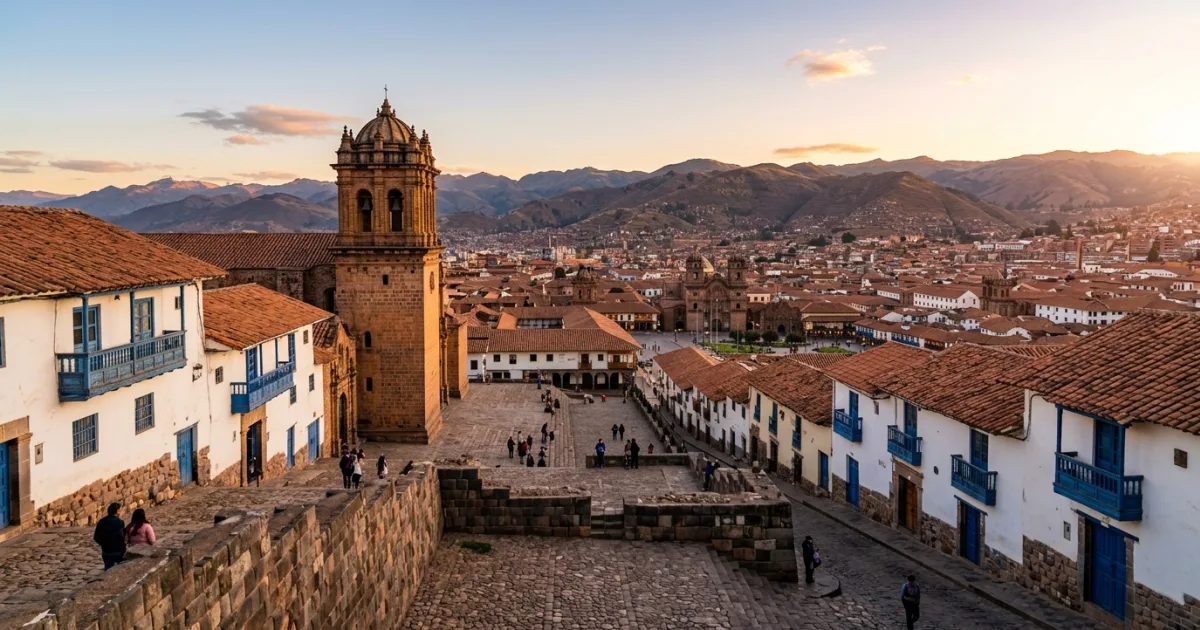
San Cristóbal holds a unique position in the urban geography and cultural memory of Cusco. Positioned upon the dramatic northern slope overlooking the ancient capital of the Tawantinsuyu, the barrio originated around Qolqampata, the fortified palace complex credited to the founder Manco Cápac. Following the Spanish conquest, the area was granted to Cristóbal Paullu Inca, an Incan royal who aligned with the Spanish crown, resulting in the early construction of the hermitage and church of San Cristóbal in the mid-16th century.
Today, the neighborhood preserves an extraordinary juxtaposition of colossal imperial stonework alongside whitewashed colonial walls accented by deep blue wooden balconies. The broad open plaza serves as a gathering space where travelers and locals alike pause to contemplate the imperial layout of the city below. Cobbled streets wind through sleepy corners where elderly Quechua women spin sheep and alpaca wool on hand spindles, seamlessly contrasting with modern specialty coffee shops framing breathtaking sunset panoramas.
Reasons to Visit
- Unmatched panoramic views overlooking the entire red-tiled expanse and colonial cathedral towers of historic Cusco
- Direct physical encounters with massive imperial Inca cyclopean stonework at the historic Qolqampata palace foundations
- Historic 16th-century San Cristóbal Church featuring an open stone campanile with 360-degree photography vistas
- Convenient walking path connection toward the monumental fortress of Sacsayhuamán and the Cristo Blanco statue
- Relaxed, bohemian ambiance with quiet rooftop coffee terraces far less congested than the downtown core
Things to Avoid
- Avoid walking up the steep Cuesta de San Cristóbal on your very first day in Cusco; give your body time to acclimatize to 3,400 meters.
- Avoid wearing flat, smooth-soled dress shoes, as the historic polished river cobblestones become slick, particularly in damp weather.
- Do not accept unsolicited tours from non-official guides loitering around the square without verified official credentials.
- Avoid wandering isolated, unlit paths heading toward the Sacsayhuamán periphery late at night.
Local Transportation Tips
San Cristóbal is best explored on foot, allowing travelers to discover historic archways, quiet stone courtyards, and scenic lookouts. To bypass the strenuous uphill walk from the Plaza de Armas, flag down any local yellow or white registered taxi along the main avenues; fares generally range between 7 and 10 PEN ($2 to $3 USD). Local microbuses (combis) such as the 'Cristo Blanco' or 'Señor del Huerto' route run up along the circumvallation road, providing an authentic transit alternative for under 1.50 PEN.
Travel Etiquette
- Always ask for permission before photographing local Quechua women, children, or their accompanying alpacas, and offer a modest tip (propina) of 2 to 5 PEN when agreed.
- Lower your voice and remove hats when entering the historic interior of the Church of San Cristóbal during active liturgical services.
- Do not sit, stand, or climb upon the fragile ancient Incan stone walls of Qolqampata.
- Carry your waste back to public bins on the plaza to preserve the neighborhood's clean historic streets.
Recommended Age Group
San Cristóbal is a rewarding historical neighborhood, though its steep topography shapes its suitability across different traveler age demographics.
- Babies (0-2 years): Not Recommended. The steep, narrow stairways and rough historic cobblestones make standard strollers impossible to use, and high altitude requires caution for infants.
- Kids (3-12 years): Neutral. Children may tire rapidly while hiking up the steep slopes, but they will enjoy the expansive open space of the plaza and seeing alpacas along the route if properly acclimatized.
- Teens (13-19 years): Recommended. Teenagers will appreciate the panoramic photo opportunities, vibrant street culture, and easy access to ancient archaeological complexes.
- Adults (20-64 years): Recommended. Perfect demographic to savor the historical depth, boutique viewpoint cafés, colonial architecture, and active uphill exploration.
- Seniors (65+ years): Neutral. Older travelers who take taxis directly to the plaza can comfortably enjoy the breathtaking views and flat church square; however, the steep cobblestone stairs can present fall hazards or altitude-related strain.
Accessibility Level: Low
- Physical accessibility is limited throughout the barrio due to uneven historical river cobblestones, steep inclines, and ancient stone staircases without handrails.
- Wheelchair users can reach the central Plaza de San Cristóbal by hiring an accessible taxi or private vehicle via Calle Don Bosco, which has roadway access directly adjacent to the lookout.
- The interior of the church features historical stone thresholds and steps, and climbing the bell tower involves a tight, narrow spiral staircase unsuitable for individuals with mobility challenges.
- Public rest facilities around the square are basic and lack dedicated barrier-free adaptations.
Did You Know?
The Church of San Cristóbal was constructed at the request of Incan Prince Cristóbal Paullu Inca, who was baptized in 1543. In 2007, archaeological excavations underneath the church nave uncovered crypts containing royal Incan remains, cementing the site's role as a major bridge between pre-Hispanic and colonial power.
Cool Statistics
- Altitude: Approximately 3,450 meters (11,318 feet) above sea level
- Foundation of the church: Circa 1545 by Cristóbal Paullu Inca
- Walking distance from Cusco's Plaza de Armas: Only 650 meters, but with an elevation gain of roughly 60 vertical meters
- Historic significance: Site of Qolqampata, historically considered the earliest royal palace of the Incan civilization






Buy a compatible power adapter for your trip