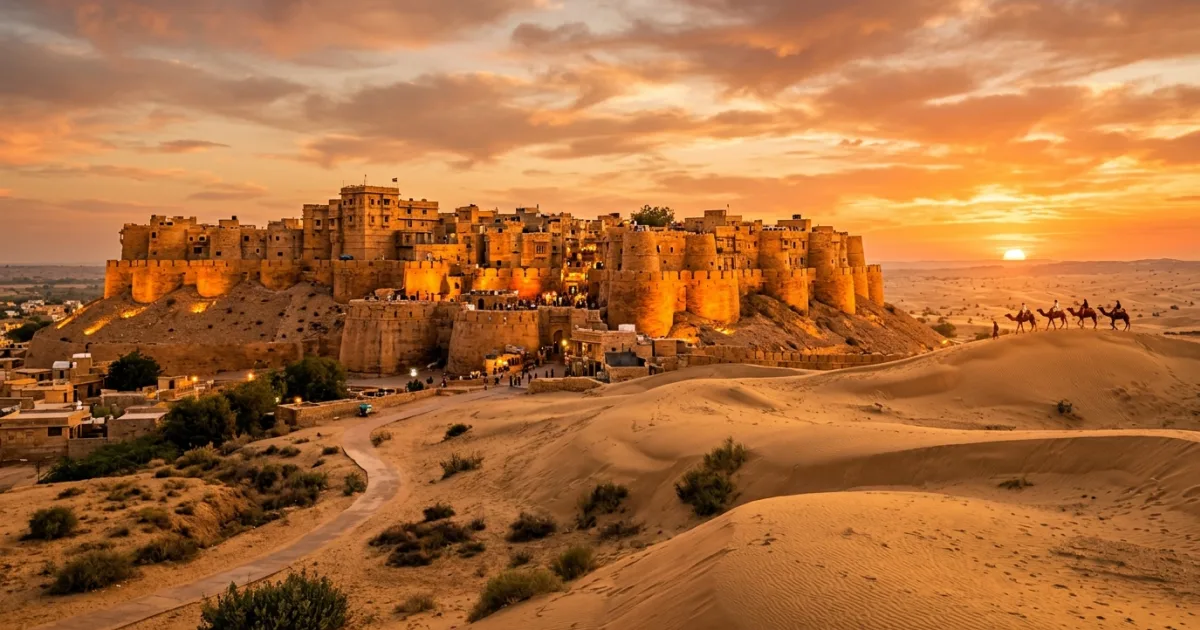
Jaisalmer rises like a mirage out of the western Thar Desert in Rajasthan. Founded in 1156 AD by the Rajput ruler Rawal Jaisal, it served for centuries as a vital nexus along the wealthy ancient caravan trade routes linking India, Persia, and Central Asia. The trade in spices, silk, and opium funded the lavish mansions and fortresses that remain remarkably preserved today. The entire town is constructed from fine-grained Jurassic yellow sandstone, which reflects an amber glow under midday sun and transforms into deep burnished gold at twilight.
Unlike preserved museum citadels elsewhere in the world, the massive Jaisalmer Fort—known locally as Sonar Qila—remains one of the planet's very few fully functional living forts. Roughly one-quarter of the town's historical population still resides inside its 99 defensive bastions. Walking through the narrow, cobbled alleys brings travelers past families cooking over hearths, sacred cows lounging near carved doorway architraves, and master artisans chiseling sandstone with techniques passed down over generations.
Reasons to Visit
- A Rare Living Fort: Wander inside Sonar Qila, where temples, merchant houses, shops, and multi-generational families thrive within 12th-century defensive stone bastions.
- Stunning Sandstone Havelis: Marvel at the breathtaking filigree stonework and cantilevered balconies of Patwon Ki Haveli and Salim Singh Ki Haveli.
- Thar Desert Safaris: Experience overnight camping under pristine dark skies amidst the undulating desert ripples of the Thar.
- Magnificent Jain Temples: Discover seven interconnected 15th- and 16th-century yellow sandstone Jain sanctuaries renowned for detailed ceiling carvings.
- Vibrant Rajasthani Folklore: Experience hypnotic Kalbelia dance performances, Manganiyar folk music, and vibrant handmade leather and textile crafts.
Things to Avoid
- Avoid booking low-cost camel safaris without verifying sanitation, animal welfare practices, and whether the camp uses loud generators throughout the night.
- Do not accept unsolicited business or gems-for-resale proposals from street acquaintances inside the fort.
- Avoid visiting between April and June, when daytime desert heat regularly reaches life-threatening levels above 45°C (113°F).
- Do not climb onto fragile exterior haveli balconies or carvings marked for structural preservation.
- Never photograph residents or temple ceremonies without asking prior permission.
Local Transportation Tips
Jaisalmer is highly walkable, particularly within the historic fort and the immediate surrounding old town markets where vehicles are restricted. For travel to sights slightly farther away, such as Gadisar Lake, Bada Bagh, or the train station, motorized three-wheeled auto-rickshaws provide inexpensive and readily available transit. Always negotiate and agree upon the fare before stepping into a rickshaw, as meters are rarely utilized. For trips to desert sand dunes (Sam or Khuri) located 40 to 45 kilometers away, hiring a private air-conditioned taxi or arranging transport through your camp is standard.
Travel Etiquette
- Remove shoes, leather accessories, and belts before entering any Jain or Hindu temple complex.
- Dress modestly by ensuring shoulders and knees remain covered when walking in town or holy sites.
- Greet locals with folded hands and a respectful 'Namaste'.
- Use your right hand when exchanging money, eating food, or handing objects to people.
- Respect the living community inside the fort by keeping noise levels low in residential quarters late in the evening.
Recommended Age Group
Jaisalmer offers exceptional cultural and visual stimuli, though its rugged desert topography and ancient paved paths influence accessibility for various age demographics.
- Babies (0-2 years): Neutral. The dusty climate, intense daytime solar radiation, and uneven cobblestones make strollers useless; baby carriers and strict hydration planning are mandatory.
- Kids (3-12 years): Recommended. Children are consistently enthralled by camel rides across towering sand dunes, starry campfire nights, and the fairytale castle feel of the living fort.
- Teens (13-19 years): Recommended. Outstanding opportunities for photography, quad biking in the desert, rooftop exploration, and vibrant craft shopping.
- Adults (20-64 years): Recommended. A premier cultural and heritage journey offering incredible architecture, rich culinary trails, and romantic desert glamping.
- Seniors (65+ years): Neutral. While the monuments are spellbinding, the fort’s steep inclines, uneven cobblestone alleys, and lack of elevators in heritage properties demand reasonable mobility.
Accessibility Level: Medium
- Navigating the medieval interior of Jaisalmer Fort presents significant challenges for wheelchair users due to steep ramps, high stone thresholds, and irregular paving stones.
- Auto-rickshaws can access the fort's main square, but inner residential lanes and Jain temples can only be reached on foot.
- Desert tent camps generally feature loose sand paths, though select upscale glamping resorts have installed wooden boardwalks leading to sleeping tents.
- Accessible vehicles with lifts are scarce in this desert outpost; private taxis must be negotiated to assist travelers with restricted mobility.
Did You Know?
Jaisalmer Fort is built entirely without the use of mortar. The immense honey-hued sandstone blocks were cut with such astonishing mathematical precision that they lock together using a system of tongue-and-groove joints, allowing the structure to flex naturally during seismic activity.
Cool Statistics
- Jaisalmer Fort contains 99 stone bastions, 92 of which were erected between 1633 and 1647.
- The citadel houses roughly 3,000 to 4,000 permanent residents within its fortified walls.
- Temperatures in the Thar desert surrounding Jaisalmer can fluctuate by more than 20°C (36°F) within a single 12-hour period between day and night.






Buy a compatible power adapter for your trip