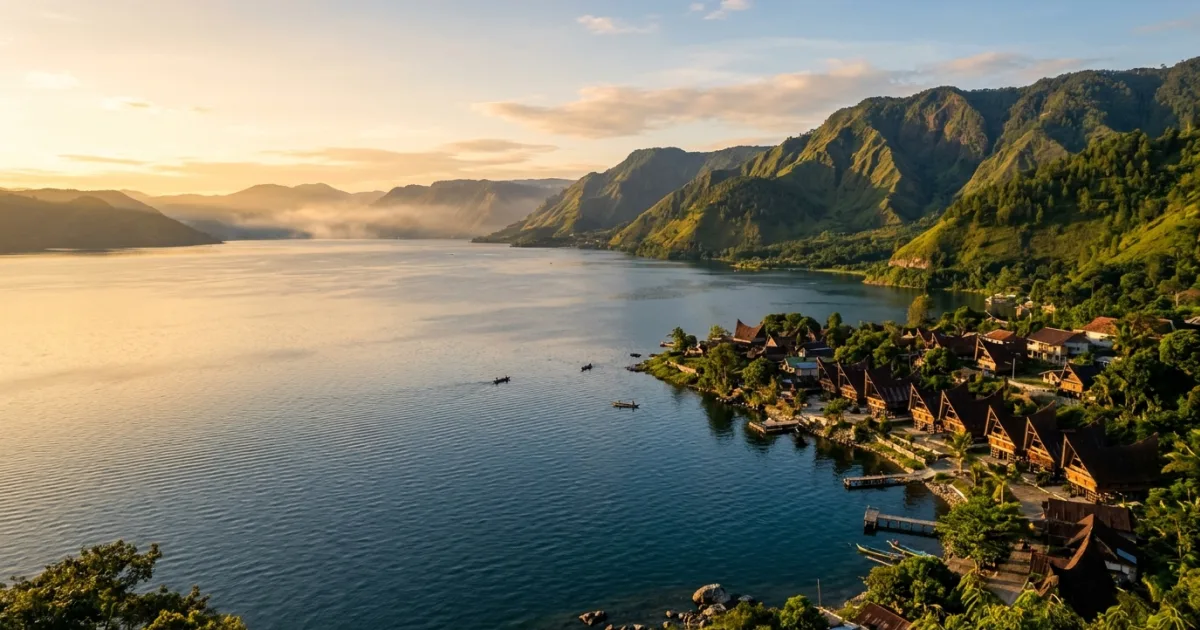
Lake Toba represents one of the most awe-inspiring geological landmarks on Earth, formed during an immense supervolcanic eruption approximately 74,000 years ago that triggered a planetary volcanic winter. Today, that vast collapsed caldera cradles a serene inland sea measuring 100 kilometers long and 30 kilometers wide, flanked by towering volcanic cliffs and terraced green hillsides. Positioned inside the lake is Samosir Island, a resurgent volcanic dome that rivals Singapore in surface area and serves as the cultural heartland of the Batak Toba ethnic group.
Beyond its geological drama, Lake Toba enchants visitors with its preservation of indigenous heritage. In villages such as Huta Siallagan and Tomok, travelers can inspect centuries-old stone megaliths, traditional high-peaked timber longhouses decorated with symbolic red, black, and white wood carvings, and sacred royal tomb sites. The confluence of comfortable highland weather, deep volcanic waters, and hospitable Batak warmth establishes Lake Toba as a premier destination for slow, restorative travel in Southeast Asia.
Reasons to Visit
- Witness the vast expanse of the planet's largest volcanic crater lake, framed by 1,000-meter caldera escarpments.
- Discover living indigenous culture across Samosir Island through ancestral megalithic stone chairs, traditional Batak dances, and authentic woodcraft architecture.
- Escape tropical heat with refreshing year-round highland temperatures ranging between 20°C and 26°C.
- Explore dramatic geological wonders including the 120-meter Sipiso-Piso waterfall plunging from the northern crater edge directly toward the lake basin.
- Relax in therapeutic natural volcanic hot springs along the slopes of Mount Pusuk Buhit near Pangururan.
Things to Avoid
- Avoid driving motorbikes around Samosir Island at night, as mountain roads lack streetlights and frequently feature potholes, gravel patches, and stray domestic animals.
- Do not swim too far out into open water beyond designated harbor areas, where deep thermal currents and boat traffic pose safety hazards.
- Avoid touching the heads of local residents or gesturing with your left hand, as these actions violate traditional Indonesian and Batak social codes.
- Avoid visiting without sufficient local cash, as ATM networks on Samosir Island are sparse and prone to power or internet interruptions.
Local Transportation Tips
Getting around Lake Toba centers on a combination of water transport and two-wheeled road travel. Public wooden passenger ferries depart hourly between the mainland port of Ajibata in Parapat and the tourist peninsula of Tuk Tuk on Samosir Island, dropping passengers directly at private resort docks along the water. For mainland car transport, the roll-on/roll-off (Ro-Ro) car ferry connects Ajibata with Tomok.
Once on Samosir Island, renting an automatic scooter is the most flexible and popular method for exploring scenic coastal roads and elevated viewpoints. Alternatively, travelers can arrange full-day private vehicle charters with local English-speaking drivers through hotels in Tuk Tuk or utilize local passenger minibuses (angkot) running along the primary paved ring road between Tomok, Ambarita, and Pangururan.
Travel Etiquette
- Greet locals with the warm, open-handed phrase 'Horas!' when arriving in Batak villages or entering local shops.
- Dress respectfully by covering shoulders and upper legs when visiting traditional ancestral sites, churches, and royal tombs like Huta Siallagan.
- Always remove footwear before stepping onto the veranda or inside a traditional wooden Batak jabu home unless instructed otherwise by your host.
- Use your right hand when offering money, accepting items, or dining, as the left hand is traditionally viewed as unhygienic.
Recommended Age Group
Lake Toba offers broad appeal across diverse age demographics thanks to its mix of leisurely scenic boat rides, engaging cultural architecture, and outdoor nature exploration.
- Babies (0-2 years): Neutral. The cool highland climate is gentle for infants, but bumpy secondary roads, lack of stroller-friendly walkways, and steep ferry steps require reliance on baby carriers.
- Kids (3-12 years): Recommended. Children thoroughly enjoy open-air ferry rides, shallow freshwater swimming coves, seeing water buffalo along village roads, and observing ancient stone structures.
- Teens (13-19 years): Recommended. Excellent destination for active teenagers interested in kayaking, light hiking around waterfalls, mountain biking, and exploring supervolcano geology.
- Adults (20-64 years): Recommended. Ideal for slow travel, cultural discovery, scenic motorbike touring, photography, and wellness relaxation along the tranquil lakefront.
- Seniors (65+ years): Neutral. Older travelers who enjoy scenic serenity will appreciate the peaceful atmosphere, though uneven stone pathways and unpaved boarding docks demand surefootedness.
Accessibility Level: Medium
- Mobility challenges are common across Lake Toba due to irregular terrain, steep dock gangways, and lack of curb ramps in lakeside villages.
- Public wooden ferries and speedboats generally feature stepped entrances without dedicated wheelchair ramps or barrier-free boarding infrastructure.
- Key cultural sites like Huta Siallagan involve uneven cobblestones, dirt paths, and raised thresholds leading into traditional timber houses.
- Travelers requiring accessible amenities should book modern lakefront resorts in Parapat or Tuk Tuk with ground-floor garden rooms and arrange private adapted vehicle transfers in advance.
Did You Know?
The supereruption that produced Lake Toba roughly 74,000 years ago is considered one of the largest explosive volcanic events in Earth's history, ejecting an estimated 2,800 cubic kilometers of volcanic ash into the atmosphere and altering global weather patterns for years.
Cool Statistics
- Elevation: Approximately 905 meters (2,969 feet) above sea level, ensuring perpetually cooler highland breezes.
- Maximum Depth: Reaches depths of up to 505 meters (1,657 feet), ranking it among the deepest lakes in the world.
- Surface Area: Encompasses over 1,145 square kilometers, making it larger than the entire nation of Singapore.






Buy a compatible power adapter for your trip