Okayama Prefecture serves as a geographic and cultural crossroads on the southern coast of Honshu's Chugoku region. Facing the calm archipelago waters of the Seto Inland Sea, the area is historically celebrated as Kibi Province, an influential ancient realm that rivaled the early Yamato court. Its moniker as the 'Land of Sunshine' (Hare no Kuni) stems from statistical meteorological records indicating the highest proportion of clear, rainfall-free days across mainland Japan.
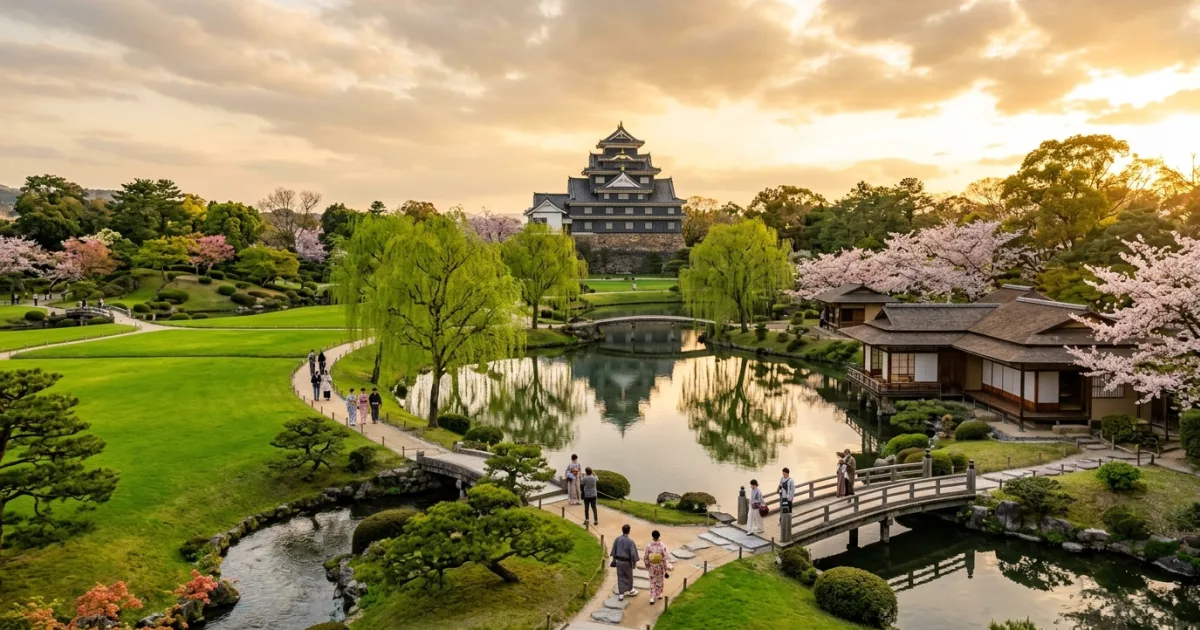
Today, Okayama harmonizes historic preservation with seamless modern efficiency. Okayama City revolves around the striking black facade of Okayama Castle, affectionately dubbed 'U-jo' (Crow Castle), which sits adjacent to Koraku-en Garden, an expansive 17th-century Daimyo landscape featuring flowing streams, tea houses, and crane sanctuaries. Further west, Kurashiki preserves tranquil canals once used to ferry rice to national markets, now lined with museums, artisanal denim boutiques, and tearooms that make the prefecture an essential stop on the Sanyo travel corridor.
Reasons to Visit
- Koraku-en Garden: Experience one of Japan's Three Great Gardens, renowned for panoramic strolling paths, borrowed scenery of Okayama Castle, and peaceful tea ceremonies.
- Kurashiki Bikan Historical Quarter: Stroll alongside weeping willow canals bordered by preserved 17th-century merchant warehouses and world-class collections at the Ohara Museum of Art.
- Fabled Fruit Capital: Delight in Japan's most prized sweet harvests, particularly melting Shimizu white peaches, Pione grapes, and fragrant Muscat of Alexandria.
- Bitchu Matsuyama Castle: Marvel at one of Japan's twelve original surviving keeps, perched high atop a mountain ridge that appears to float on an ethereal sea of morning clouds in autumn.
- Birthplace of Japanese Denim: Explore the seaside district of Kojima, celebrated globally as the epicenter of artisanal Japanese selvedge denim craftsmanship.
Things to Avoid
- Avoid skipping Kurashiki's side alleys, as many of the finest Bizen pottery workshops, traditional denim ateliers, and micro-cafés lie tucked behind the primary canal thoroughfare.
- Do not rely entirely on credit cards or mobile payment apps when shopping at heritage sweet stores, canal boat ticket booths, or rural train stations.
- Avoid planning outdoor mountain viewing at Bitchu Matsuyama Castle late in the day; the famous 'sea of clouds' phenomenon occurs almost exclusively in early morning during autumn and winter.
- Do not miss the evening illuminations at Koraku-en and Okayama Castle during seasonal summer and autumn night openings.
Local Transportation Tips
Okayama Station functions as the principal transit hub of western Japan, offering rapid Shinkansen connections eastward toward Osaka and Tokyo, westward toward Hiroshima and Fukuoka, and southward across the Great Seto Bridge into Shikoku. Within Okayama City, the historic Okaden tramway provides clean, frequent transit linking the central station directly to Okayama Castle and Koraku-en. Local JR lines like the Sanyo Line and Hakubi Line link surrounding highlights such as Kurashiki, Kojima, and Takahashi with pinpoint punctual departures.
Travel Etiquette
- Keep your voice low on public transit and switch mobile phones to silent 'manner mode' at all times.
- Remove shoes promptly when stepping onto raised tatami areas in tea houses, historical residences, and traditional accommodations.
- Refrain from walking while eating street treats along Kurashiki's canals; consume snacks in front of the shop where purchased.
- Handle centuries-old wooden structures with care and strictly respect indoor photography restrictions in temples and private art galleries.
Recommended Age Group
Okayama Prefecture offers an exceptionally comfortable, diverse travel experience spanning pristine samurai castles, picturesque canals, and barrier-free transportation suited for multi-generational journeys.
- Babies (0-2 years): Neutral. Paved paths around Okayama Castle and Koraku-en accommodate strollers well, though historic bridges and stepped warehouse entries in Kurashiki may require carrying infants.
- Kids (3-12 years): Recommended. Children enjoy folklore stories of Momotaro, scenic canal boat rides in Kurashiki, feeding koi carp in Koraku-en ponds, and sampling peach confections.
- Teens (13-19 years): Recommended. Older youth appreciate authentic Japanese denim customization in Kojima, bicycle tours through the Kibi Plain, and hands-on Bizen pottery experiences.
- Adults (20-64 years): Recommended. Adults will relish the relaxed pace, world-renowned modern and impressionist art collections, historic castle walks, and outstanding Seto Inland Sea dining.
- Seniors (65+ years): Recommended. Smooth Shinkansen access, flat garden footpaths, punctual tramways, and high medical and civic security ensure a serene, low-stress holiday for mature travelers.
Accessibility Level: Medium
- Okayama Station and Kurashiki Station feature comprehensive step-free access, tactile paving, accessible restrooms, and multi-lingual elevator systems.
- Koraku-en Garden provides wheelchair-friendly paved perimeter circuits, gentle ramps, and free manual wheelchair loans at main ticket offices.
- Modern low-floor streetcars operate on Okayama's Okaden tram lines, facilitating smooth boarding for passengers with mobility limitations.
- Certain preserved historical buildings and traditional wooden castle keeps retain steep stairs and narrow doors that present physical mobility challenges.
Did You Know?
Okayama is the legendary birthplace of Momotaro (the 'Peach Boy'), one of Japan's most beloved folklore tales. According to local legend, Momotaro was discovered floating down a river inside a giant peach before growing up to battle demons on Onigashima Island with the help of a talking dog, monkey, and pheasant. Momotaro iconography decorates everything from Okayama Station's plaza statue to local manhole covers and confection boxes.
Cool Statistics
- Okayama Prefecture enjoys an average of roughly 275 sunny days annually, earning its official provincial title as the 'Land of Sunshine'.
- Koraku-en Garden encompasses over 13 hectares of manicured lawns, waterways, and bamboo groves created over 300 years ago by Daimyo Ikeda Tsunamasa.
- Kojima Jeans Street in southern Okayama houses more than 40 bespoke artisanal denim mills and boutique workshops specializing in shuttle-loomed indigo fabrics.






Buy a compatible power adapter for your trip