Hakodate holds a distinctive place in Japanese history as one of the first five treaty ports opened to international commerce in 1859, ending centuries of national isolation. This historic maritime crossroads allowed foreign traders, diplomats, and missionaries to leave an indelible architectural imprint across the foothills of Mount Hakodate. Today, Western brick architecture and European-style chapels coexist naturally with traditional Japanese wood-frame merchant houses along the paved slopes of Motomachi.
Beyond its visual charm, Hakodate represents Hokkaido's southern cultural anchor. Its unique geography—a narrow urban isthmus bordered by Hakodate Bay and the Tsugaru Strait—creates breathtaking panoramic perspectives from elevated viewpoints. Visitors find a relaxed city pace supported by an accessible vintage tram network, world-class thermal mineral springs at Yunokawa, and a thriving seafood industry that supplies Tokyo's finest restaurants with squid, sea urchin, and kelp.
Reasons to Visit
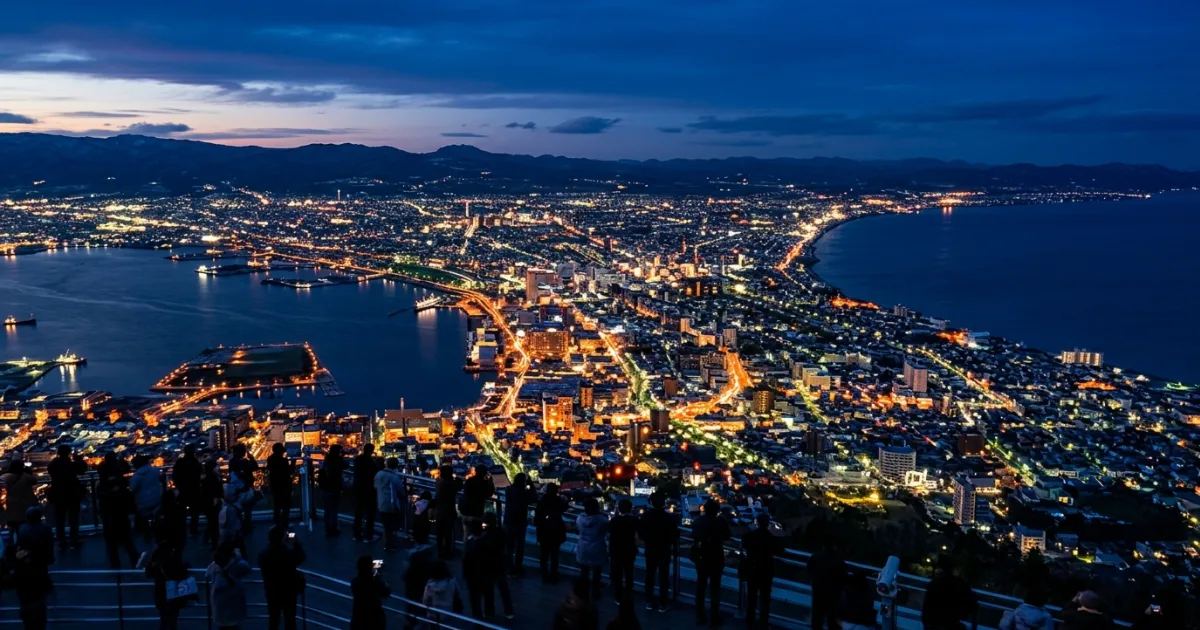
- Mount Hakodate Night Panorama: Renowned as one of Japan's top three night views, offering an hourglass-shaped skyline framed by ocean water.
- Fort Goryokaku: A French-inspired star-shaped citadel that serves as a landmark of samurai history and a premier spring cherry blossom destination.
- Hakodate Morning Market (Asaichi): A vibrant hub of over 250 stalls serving fresh seafood rice bowls, king crab, and seasonal squid.
- Motomachi District: A hillside neighborhood featuring historic consulates, the Russian Orthodox Church, and stone-paved streets leading directly to the sea.
- Yunokawa Onsen: A centuries-old coastal hot spring resort area where visitors can soak in mineral-rich waters and watch monkeys bathe in botanical hot pools during winter.
Things to Avoid
- Avoid wearing smooth-soled dress shoes during winter; the steep cobblestone hills of Motomachi become notoriously slippery without winter grips.
- Do not arrive at the Mount Hakodate Ropeway precisely at peak sunset during autumn or holiday weekends without anticipating heavy queues; arrive 45 minutes early instead.
- Avoid planning your Hakodate Asaichi morning market visit in the late afternoon, as most fresh seafood stalls close by 1:00 PM.
- Do not confuse JR Hakodate Station with Shin-Hakodate-Hokuto Station; the bullet train terminates at the latter, requiring a 15-minute connecting shuttle into town.
Local Transportation Tips
Hakodate features an exceptionally convenient and user-friendly public transit network anchored by the Hakodate City Tram (Shiden). Two tram lines run through the heart of the city, connecting Hakodate Station directly to Motomachi (Jujigai stop), Fort Goryokaku (Goryokaku-Koen-Mae stop), and the hot springs of Yunokawa. Fares are distance-based, but travelers can purchase a 1-day tram pass for 600 JPY or pay with major IC cards (Suica, Pasmo, Kitaca). City buses complement the tram network for routes up Mount Hakodate and out to Hakodate Airport.
Travel Etiquette
- Remove your shoes when entering traditional tatami dining areas, historic temples, or ryokan accommodations.
- At onsen bathhouses, wash thoroughly with soap and rinse off completely at the wash stations before stepping into communal thermal pools.
- Refrain from walking while eating street food at the Hakodate Morning Market; consume snacks near the vendor where purchased.
- Maintain quiet voices when riding the Hakodate City Tram, and keep mobile devices set to silent mode.
Recommended Age Group
Hakodate accommodates multi-generational travel with ease, thanks to smooth public transport and varied cultural attractions.
- Babies (0-2 years): Neutral. The tram system is accessible, but navigating the steep cobblestone slopes of Motomachi with a stroller requires substantial physical effort.
- Kids (3-12 years): Recommended. Children will love the observation ropeway, the retro red brick warehouses, star-shaped maze paths at Goryokaku, and the playful Lucky Pierrot burger joints.
- Teens (13-19 years): Recommended. Vibrant market street food, scenic photo backdrops across Motomachi's slopes, and historical anime connections appeal strongly to teenagers.
- Adults (20-64 years): Recommended. Outstanding seafood dining, microbreweries along the bay, rich architectural history, and coastal onsens make it an ideal retreat.
- Seniors (65+ years): Recommended. The flat tram routes, tranquil hot spring resorts in Yunokawa, and relaxed northern pacing provide high comfort for mature travelers.
Accessibility Level: Medium
- The Hakodate City Tram operates several low-floor, barrier-free accessible cars (designated as 'Amumu' and 'Komaba') equipped with boarding ramps.
- The Mount Hakodate Ropeway facilities and summit observation decks feature full elevator access, tactile paving, and accessible restroom facilities.
- Fort Goryokaku Tower offers ramp entry and wide elevators leading to panoramic wheelchair-friendly observation decks.
- Motomachi's historic hillside features steep gradients (such as Hachiman-zaka Slope) that can be challenging for manual wheelchairs; taking a taxi to the top and exploring downhill is advised.
Did You Know?
The star-shaped design of Fort Goryokaku was engineered in 1855 by scholar Takeda Ayasaburo, who drew inspiration from French military architect Vauban. The star shape minimized blind spots for defensive cannon emplacements, and the fort briefly served as the headquarters of the short-lived Republic of Ezo in 1869—Japan's only declared democratic republic.
Cool Statistics
- 334 meters: The exact elevation of Mount Hakodate's observation summit above sea level.
- 1,600: The approximate number of Somei Yoshino cherry trees planted throughout Fort Goryokaku's star ramparts.
- 1859: The year Hakodate officially opened as an international treaty port alongside Yokohama and Nagasaki.






Buy a compatible power adapter for your trip