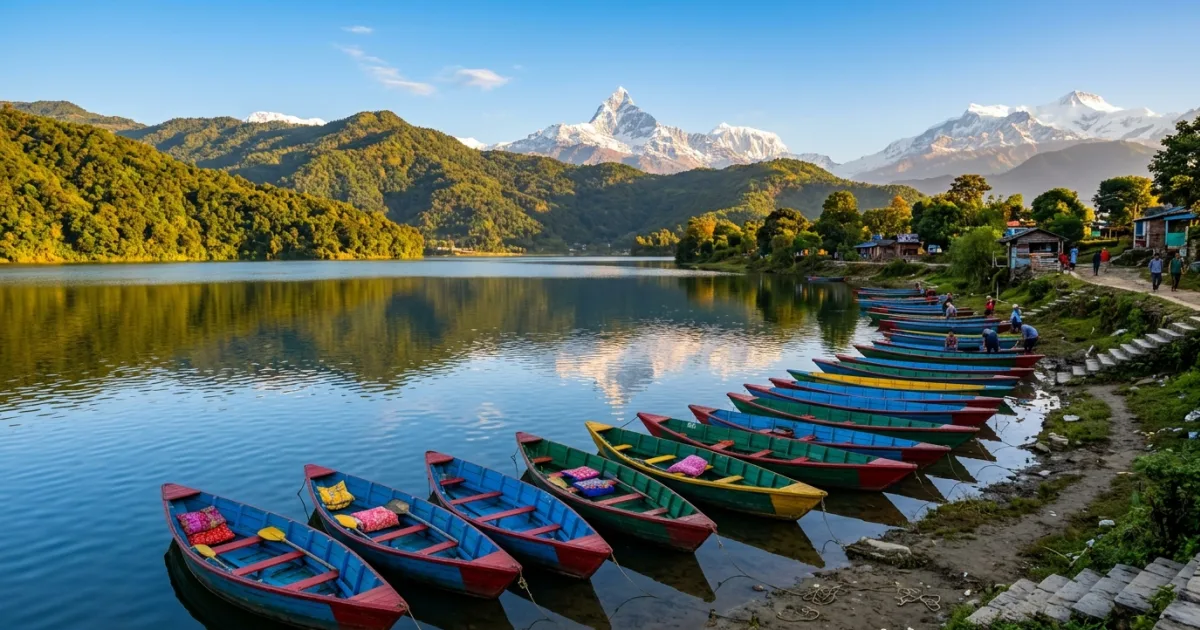
Pokhara is situated in the Gandaki Province of central Nepal, spanning a wide valley beneath the Annapurna Massif. Serving as the geographical transition between the rolling mid-hills and the high Himalayas, the city rests around 822 meters above sea level, producing a subtropical climate far milder than northern alpine zones. The visual focal point of Pokhara is Mount Machapuchare, an iconic pyramid-shaped mountain considered sacred to the Hindu god Shiva and closed to climbing summits.
Historically, Pokhara served as a vital trading post along the historic trans-Himalayan mule routes connecting Tibet with northern India. Today, the modern city divides distinctly between the bustling commercial bazaar of Mahendrapul and the tranquil traveler enclave of Baidam (Lakeside). Lakeside stretches along the eastern shoreline of Phewa Lake, filled with open-air garden bistros, yoga retreats, bookshops, and trekking agencies that outfit trekkers heading into the Annapurna Circuit or Sanctuary.
Reasons to Visit
- Witness dawn illuminate the Annapurna Range and Fishtail Peak in shades of gold from the Sarangkot ridge.
- Row colorful wooden doonga boats across Phewa Lake to reach the island shrine of Tal Barahi Temple.
- Experience world-renowned tandem paragliding thermal flights boasting panoramic mountain and valley backdrops.
- Hike through lush forested trails up to the gleaming white stupa of the World Peace Pagoda (Shanti Stupa).
- Immerse yourself in authentic mountain cultures at Tibetan refugee settlements like Tashiling and Tashi Palkhel.
Things to Avoid
- Avoid booking unregulated adventure sports operators who lack registered civil aviation certifications or commercial insurance.
- Do not swim across Phewa Lake without a personal flotation device due to dangerous subsurface currents and plant entanglements.
- Avoid hiring unvetted freelance trekking guides off street corners without verifying their official Trekking Agencies' Association of Nepal (TAAN) registration.
- Do not drink municipal tap water or unsealed bottled water; use filtered refilling stations instead.
- Avoid trekking without adequate warm garments, even on day hikes around the valley rim where mountain weather shifts abruptly.
Local Transportation Tips
Navigating Pokhara's tourist hub along Lakeside is easily accomplished on foot. For destinations beyond Lakeside, small local hatchback taxis are abundant; drivers rarely use meters for foreign travelers, requiring passengers to negotiate and agree on fares before boarding. Standard cross-town rides typically cost between 300 and 600 NPR. City microbuses run regularly from Lakeside to Old Pokhara, Mahendrapul, and the Pame lakeside trail, offering an authentic and economical transit method for 25 to 50 NPR per trip. Mountain bike and scooter rentals are available throughout Baidam Road for independent touring.
Travel Etiquette
- Always remove shoes before entering Hindu temples, Buddhist monasteries, and private homes.
- Circumambulate Buddhist chortens, stupas, and mani stone walls exclusively in a clockwise direction.
- Dress respectfully when leaving the immediate Lakeside strip by keeping knees and shoulders covered.
- Use your right hand or both hands when giving or receiving money, food, and gifts.
- Never touch anyone on the head, as the head is traditionally revered as sacred in Nepali culture.
Recommended Age Group
Pokhara provides varied activity levels suited primarily for active adventurers, nature lovers, and mature holidaymakers, though mountain terrain requires attention for young children.
- Babies (0-2 years): Not Recommended. Cracked lakeside walkways, unpaved hillside stairs, and rough local vehicles present logistical hurdles with strollers.
- Kids (3-12 years): Neutral. Calm boating on Phewa Lake and gentle hikes around Begnas Lake are enjoyable, though long bus journeys and narrow trekking trails demand constant parental supervision.
- Teens (13-19 years): Recommended. Thrilling activities like zip-lining, paragliding, mountain biking, and beginner trekking routes keep active teenagers thoroughly engaged.
- Adults (20-64 years): Recommended. An optimal base combining world-class alpine adventures, vibrant gastronomy, yoga retreats, and relaxing lakefront leisure.
- Seniors (65+ years): Neutral. Lakeside's flat terrain and serene mountain-view resorts provide wonderful relaxation, but steep staircases at the World Peace Pagoda and uneven sidewalks require mobility awareness.
Accessibility Level: Medium
- Sidewalks along Lakeside (Baidam Road) feature uneven stone flags, high curbs, and missing curb ramps that impede manual wheelchair transit.
- Major attractions like World Peace Pagoda, Sarangkot Viewpoint, and Gupteshwor Cave require climbing dozens of steep, irregular masonry stairs.
- Accessible vehicles with hydraulic lifts are exceptionally rare; standard private transfers rely on compact SUVs or sedans.
- Several premier lakefront resorts offer step-free garden villas, ground-floor dining, and roll-in showers upon advance inquiry.
Did You Know?
Despite standing only 28 kilometers south of Mount Annapurna I—the world's tenth-tallest mountain rising past 8,091 meters—Pokhara sits at an altitude of just 822 meters. This dramatic elevation drop of over 7,000 vertical meters across such a short horizontal distance forms one of the steepest topographical gradients on Earth.
Cool Statistics
- 822 meters: The modest baseline elevation of Pokhara valley above sea level.
- 28 kilometers: Direct horizontal distance from downtown Pokhara to the 8,000-meter peaks of the Annapurnas.
- 5.23 square kilometers: The total surface area of Phewa Lake, Nepal's second-largest lake.
- Over 300: Flying days per year that make Pokhara one of the premier paragliding destinations worldwide.






Buy a compatible power adapter for your trip