Patan, historically named Lalitpur or the 'City of Beauty', stands as an architectural triumph in the southern quadrant of the Kathmandu Valley. Separated from Kathmandu by the Bagmati River, this ancient settlement flourished under the Malla dynasty as an autonomous center of fine arts, metal sculpture, and classical Newar craftsmanship. Today, its urban fabric remains an active pilgrimage ground and living heritage site where Buddhist monasteries (viharas and bahals) coexist seamlessly with intricate Hindu shrines.
Beyond the celebrated Durbar Square, Patan invites slow urban wandering through hundreds of interconnected residential courtyards. In these stone-paved spaces, artisans hammer brass bowls, chisel stone deities, and roll handmade incense beneath carved wooden lattice windows. The city also accommodates a sophisticated contemporary undercurrent in neighborhoods like Jhamsikhel, featuring artisanal bakeries, fair-trade design boutiques, and contemporary art galleries.
Reasons to Visit
- Exquisite Newar woodcraft, stone carving, and bronze casting preserved within UNESCO World Heritage monuments.
- The Patan Museum, widely regarded as one of the finest curated displays of South Asian traditional art.
- Vibrant living culture characterized by morning prayer rituals, religious street festivals, and artisan traditions.
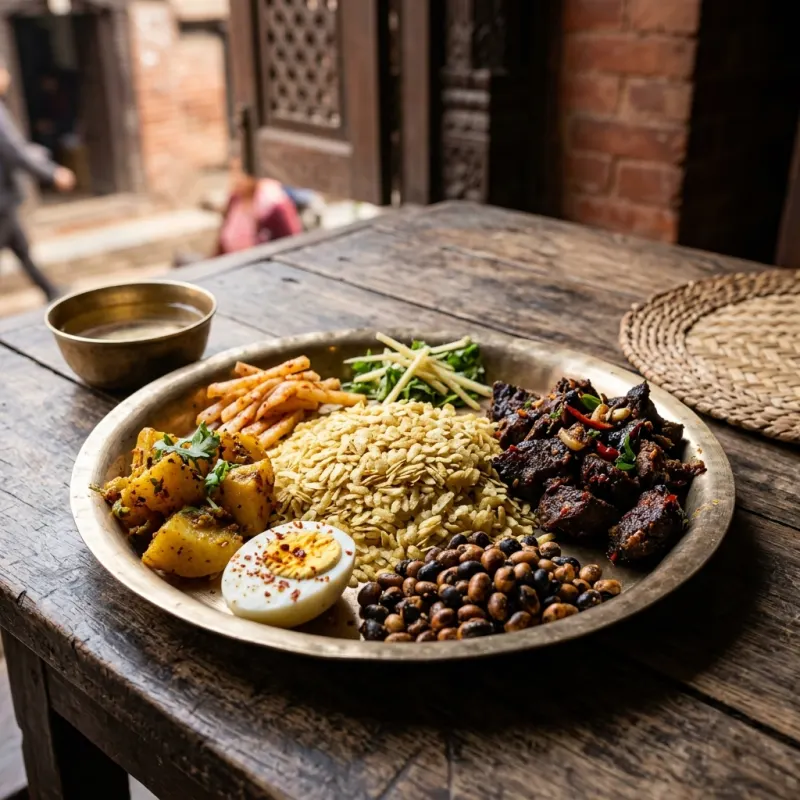
- Distinctive Newari culinary heritage featuring unique flavors not found in standard Nepali cuisine.
- Atmospheric boutique heritage stays converted from historic brick townhouses.
Things to Avoid
- Avoid walking through narrow unlit alleys late at night without a flashlight or smartphone torch.
- Do not touch religious statues or stone lingams with your feet, and avoid pointing soles of shoes at sacred objects.
- Do not photograph private family religious rituals or funeral pyres without clear permission.
- Avoid hiring unofficial guides hovering outside the ticket booths; verify credentials with authorized badges.
Local Transportation Tips
The core heritage area of Patan is best navigated on foot due to dense alleys and pedestrianized corridors. For travel between Patan and central Kathmandu, ride-hailing applications like Pathao and inDrive offer reliable motorcycle and taxi pickups with upfront pricing. Shared microbuses operate frequently along the main transit corridors, terminating near Lagankhel, though they can be crowded and require familiarity with local Nepali routes.
Travel Etiquette
- Remove your shoes before entering Hindu temples, Buddhist monasteries, and private homes.
- Circumambulate temples, stupas, and shrines clockwise as a sign of Buddhist and Hindu respect.
- Use your right hand or both hands when giving or receiving money, food, or gifts.
- Dress modestly by covering your shoulders and knees when visiting all spiritual landmarks.
Recommended Age Group
Patan is an enriching cultural destination that caters exceptionally well to independent adult travelers, cultural researchers, and curious teenagers, while requiring extra logistical preparation for young children.
- Babies (0-2 years): Neutral. Cobblestone surfaces, uneven curbs, and high door thresholds make stroller use impractical, requiring baby carriers.
- Kids (3-12 years): Neutral. Open squares offer space to explore, but dense traffic outside the monument zone and fragile historical sites demand close supervision.
- Teens (13-19 years): Recommended. Vibrant street photography, artisan workshops, vintage cafes, and interactive craft studios appeal directly to older youth.
- Adults (20-64 years): Recommended. Ideal for architectural study, historical exploration, boutique lodging, and deep culinary discovery.
- Seniors (65+ years): Neutral. While the cultural pace is peaceful and contemplative, irregular brick pavements, raised temple steps, and lack of elevators in heritage buildings require careful walking.
Accessibility Level: Medium
- Historic temple platforms and traditional courtyards feature steep stone stairs and raised wooden door sills that present significant barriers for manual and motorized wheelchairs.
- Patan Museum offers partial ground-floor accessibility and smooth courtyard pathways, though upper galleries are reached via historic timber staircases.
- Pavement across the city center is generally uneven, with missing pavers and open drainage channels requiring focused attention.
- Specialized accessible vehicles are limited in the valley; travelers with mobility limitations typically require private driver assistance and step-free boutique hotel bookings.
Did You Know?
Patan's urban layout is traditionally said to be anchored at its four cardinal corners by ancient stupas constructed during the reign of the Indian Emperor Ashoka in the 3rd century BCE, representing some of the oldest intact Buddhist earthworks in the Kathmandu Valley.
Cool Statistics
- Home to over 130 recognized historic Buddhist courtyards (bahals and bahis).
- Patan Durbar Square contains more than 55 major historic temples and commemorative shrines.
- Over 75% of Nepal's traditional lost-wax bronze sculptures are produced by master artisans based in Patan.






Buy a compatible power adapter for your trip