Disclosure: This site contains affiliate links. We may earn a commission if you make a purchase, at no extra cost to you.

>
>
>
>
Dhunche
Panoramic view of Dhunche village situated on terraced mountain slopes in the Langtang region of Nepal

Dhunche Overview & Key Highlights

Dhunche serves as the administrative headquarters of Rasuwa District and stands at an elevation of 1,960 meters within Nepal's central Himalayas. The settlement operates as the primary western overland gateway into Langtang National Park and acts as the traditional trailhead for the sacred alpine pilgrimage route to Gosainkunda Lake. Terraced hillsides, pine-clad mountain ridges, and steep river valleys surround the town, which features stone-paved alleys, family-run guesthouses, and government checkpoints. Travelers primarily use Dhunche as an acclimation stopover before embarking on multi-day treks toward high-altitude lakes or the Langtang Valley. The local population consists predominantly of Tamang communities whose culture reflects strong Tibetan Buddhist traditions, visible in prayer wheels, chortens, and mani walls throughout the settlement. While basic in infrastructure, Dhunche offers essential logistics including national park permit counters, basic medical posts, and supply shops for trekkers setting foot into the Himalayan wilderness.

Dhunche Travel Guide: Logistics & In-Depth Tips

Dhunche sits along the steep western slopes of the Trishuli River basin in Nepal's Rasuwa District. As the primary administrative center for the region, it bridges the gap between the mid-hill farming valleys and the glaciated high peaks of the Langtang Himal. The village is characterized by slate-roofed houses, local government offices, small mountain retail stores, and rustic teahouses designed to cater to both local civil servants and visiting trekkers.

For centuries, the settlement served as a trading station along the historical routes connecting central Nepal with southern Tibet. Today, Dhunche is internationally recognized as the main western jumping-off point for expeditions into Langtang National Park. From here, trails branch upward through pristine rhododendron and oak woodlands toward Sing Gompa, Lauribinayak, and the glacial tarns of Gosainkunda, while the main road continues north toward the Tibetan border crossing at Rasuwagadhi.

Reasons to Visit

  • Serves as the direct starting point for the high-altitude pilgrimage hike to sacred Gosainkunda Lake.
  • Provides authentic immersion into Tamang culture and Tibetan Buddhist village architecture.
  • Offers sweeping panoramic views across deep valleys toward the Ganesh Himal range.
  • Acts as an essential supply point and permit verification hub for Langtang National Park explorations.
  • Features a cooler, refreshing mountain climate away from the dense heat and congestion of Kathmandu.

Things to Avoid

  • Avoid traveling on the Kathmandu-Dhunche road during peak monsoon season (July to August) due to serious landslide risks.
  • Do not rely on local bank ATMs in Dhunche to replenish your entire trekking cash reserve.
  • Avoid rapid ascent itineraries from Dhunche to Gosainkunda without scheduling an acclimatization overnight stop at Sing Gompa or Chandanbari.
  • Do not enter forested sections of Langtang National Park without official entry permits and registered guides.

Local Transportation Tips

Local transportation within Dhunche is conducted exclusively on foot, as the compact town is arranged around a steep central thoroughfare and pedestrian stone stairs. Regional connectivity depends on local shared buses, scheduled minibuses, and private four-wheel-drive jeeps operating between Machhapokhari bus terminal in Kathmandu and the Dhunche bus stop. For forward transit toward Syabrubesi, shared jeeps and local buses pass through the main checkpoint several times daily.

Travel Etiquette

  • Always walk clockwise around Buddhist chortens, mani stone walls, and prayer wheels.
  • Remove your shoes before entering local Buddhist monasteries, family homes, and temple premises.
  • Ask for permission before photographing residents, particularly elderly villagers and monks.
  • Dress modestly by covering shoulders and knees when exploring village alleys and sacred shrines.
  • Use both hands or your right hand when giving or receiving money and hospitality items.

Recommended Age Group

Dhunche is a remote mountain staging post characterized by steep terrain, rough dirt tracks, and basic medical facilities, which heavily determines its suitability across demographic groups.

  • Babies (0-2 years): Not Recommended. The prolonged, jarring 7-hour road journey over mountainous roads, combined with limited emergency pediatric care and cold mountain weather, presents significant discomfort and health risks.
  • Kids (3-12 years): Not Recommended. The harsh travel logistics, lack of dedicated entertainment, and steep mountain stairways make Dhunche unsuitable for young children unless they are highly accustomed to rugged overland expeditions.
  • Teens (13-19 years): Recommended. Active teenagers with a passion for geography, outdoor trekking, and Himalayan mountain culture will find the gateway town an exciting prelude to wilderness hiking.
  • Adults (20-64 years): Recommended. Adult hikers, cultural adventurers, and backpackers will thoroughly appreciate the authentic mountain atmosphere, local cuisine, and direct trail access into the national park.
  • Seniors (65+ years): Neutral. Older travelers who possess excellent physical mobility and cardiovascular stamina can enjoy Dhunche, though the rugged transport access and uneven stone paving require high endurance.

Accessibility Level: Low

  • Dhunche features steep hillside topography with narrow stone staircases and unpaved, rocky pathways, presenting severe mobility barriers for wheelchair users.
  • Local guesthouses and public facilities lack step-free access, ramps, automated doors, or specialized ADA-compliant bathrooms.
  • Transport vehicles operating between Kathmandu and Dhunche are standard high-clearance jeeps and buses without accessibility lifts or secure wheelchair tie-downs.
  • Pavements along the main road are largely absent, requiring pedestrians to navigate uneven shoulders shared with vehicular traffic.

Did You Know?

Dhunche hosts a dedicated processing plant for traditional Himalayan yak cheese at nearby Chandanbari, originally established with Swiss development assistance in the mid-20th century, which still produces firm, savory mountain cheese using centuries-old pasture techniques.

Cool Statistics

  • Elevation: 1,960 meters (6,430 feet) above sea level.
  • Distance from Kathmandu: approximately 118 kilometers via the Pasang Lhamu Highway.
  • Annual visitor gateway to Langtang National Park, which protects over 1,710 square kilometers of biodiversity.
  • Home to over 4,000 residents in the surrounding Dhunche village development committee.

Address:

Dhunche, Rasuwa District, Nepal

Find Nearby Accommodations

Basic Info

address icon

COUNTRY & Region

Nepal,
Asia

ACCESSIBILITY LEVEL​

Low
Currency icon

LOCAL CURRENCY​

Nepalese Rupee (NPR)
Price level icon
Low
Safety Level icon

SAFETY LEVEL

Duration icon

Recommended Duration

• Overnight
• 1-7 days

Electricity

electricity icon

Electricity

220-240V, 
50Hz
Plug Socket icon

Plug Type

• Type C (Round pin)
• Type D (Three round pins in a triangular pattern)
• Type M (Three round pins, larger)
Plug types
Click To View Plug Types
Dhunche is part of our
Coolcation collection

Activities To Do In Dhunche

Best Time To Visit Dhunche

Trekking conditions around Dhunche depend entirely on the seasonal monsoon and alpine snow patterns.

  • March to May (Spring): Prime trekking season featuring daytime temperatures of 12°C to 18°C, blooming rhododendron forests, and clear morning vistas of the Ganesh Himal range.
  • September to November (Autumn): The most stable weather window with crystalline skies, minimal precipitation, crisp mountain air, and daytime highs around 15°C, making it the most popular time for Gosainkunda hiking.
  • December to February (Winter): Cold and dry with temperatures dropping below freezing at night, occasional snowfalls that can block upper trails, but offering exceptionally clear ridge views for prepared travelers.
  • June to August (Monsoon): Not recommended due to heavy rains, frequent landslides along the Pasang Lhamu Highway, and active leech populations on lower forested tracks.

Average Temperatures Per Month

Remember to check the weather forecast a few days before the trip and before heading to the airport.

Safety Level icon

Safety Level

Violent crime in Dhunche is practically nonexistent, making the village extremely safe from social hazards. The primary risks stem from the perilous Pasang Lhamu Highway connecting Kathmandu to Dhunche, where monsoonal landslides and rough cliffs demand cautious transit in roadworthy vehicles. Furthermore, trekkers ascending toward Gosainkunda must monitor for symptoms of Acute Mountain Sickness (AMS) and allow proper acclimatization.

The rating is based on multi-year peace, crime, and security indices. Before you go, always verify current conditions through official government travel advisories.

Emergency Numbers

Police: 100
Ambulance: 102

No internet needed • Includes local translations • Free for TravelingWiz readers

Spoken Languages

Nepali, Tamang, and basic English among tourism operators

Learn The Language

  • Namaste — Hello / Respectful greeting
  • Dhanyabad — Thank you
  • Kasto cha? — How are you?
  • Thik cha — I am fine / All good
  • Kati ho? — How much is this?
  • Paani dinuhos — Please give me water
  • Bistarai jaanu — Go slowly / Travel safely
  • Maaf garnuhos — Excuse me / Sorry
Travel Booking Partner - TravelingWiz

Trip Cost & Budgeting for Dhunche, 2026

Everything you need to know about money while traveling
Dhunche is not expensive for tourists in 2026, offering very affordable Himalayan travel costs. You can expect to pay around 300 NPR for a coffee, 600 NPR for a domestic beer, and 750 NPR for a filling main meal like dal bhat at local eateries. Based on Human Verified prices, staying and dining here remains remarkably budget-friendly. Use the data table below to calculate your specific daily budget based on your travel style.
Currency icon

LOCAL CURRENCY​:

Nepalese Rupee (NPR)
Price level icon
Low
Cash is absolute king in Dhunche; credit cards are rarely accepted anywhere in this mountain town.

Per person, per day – pocket cash for small purchases.

Local: 450
Nepalese Rupee (NPR)
≈ 3 USD

Full daily spend estimation (accommodation, food, transportation, attractions).

Travel Style
Nepalese Rupee (NPR)
≈ USD ($)
Budget
2500
16
Mid-range
4500
30
Comfort
9900
65

The Prices, Daily costs, and calculator results are estimates for planning purposes only. Actual costs may vary based on season, booking timing, personal spending habits, and currency fluctuations. TravelingWiz cannot be held responsible for discrepancies between these estimates and your final trip expenses.

  • • Order traditional Dal Bhat for meals because it includes free refills and provides maximum energy for hiking.
  • • Withdraw all necessary NPR cash in Kathmandu, as Dhunche ATMs are frequently unreliable or out of cash.
  • • Purchase your Langtang National Park permits directly at the Dhunche army checkpoint to avoid extra agency markup fees.
  • • Take public buses or shared jeeps from Kathmandu rather than private transfers to drastically lower your transport expenses.

Pre-Order Tickets

Avoid disappointment when tickets sell out — and skip the long lines by booking online in advance. You’ll often save up to 20% too.
Save up to 20%

Travel Discounts & Coupons

Save on hotels, attractions, transport, and gear — find verified discounts for smarter travel spending.
Verified Coupons

What To Pack

  • Sturdy broken-in trekking boots with deep lug soles for steep Himalayan footpaths
  • Layered moisture-wicking apparel, thermal base layers, and an insulated down jacket
  • Waterproof and windproof shell jacket for unpredictable mountain showers
  • Water purification tablets or UV sterilizer bottle to treat mountain tap water
  • High-SPF sunscreen, polarized sunglasses, and broad-brim sun hat for intense high-altitude UV
  • Ample cash in Nepalese Rupees, as local ATMs frequently run out of funds or suffer power outages
  • Personal first aid kit containing altitude sickness medication (Diamox), blister dressings, and rehydration salts
  • Universal plug adapter and a high-capacity portable power bank for frequent regional power fluctuations
We couldn't find tips for Dhunche.
If you got any, please share

Recommended Itineraries for Traveling to Dhunche

We couldn't find itineraries for Dhunche.
you can contact us for custom trip plan

Food & Drink Highlights

Local Food Overview

Dining in Dhunche centers on hearty, energy-rich Himalayan sustenance designed to sustain manual labor and strenuous mountain ascents. Teahouses and small family kitchens prepare meals from scratch using staple crops like buckwheat, barley, millet, potatoes, and mustard greens. Tibetan cultural influences are prominent, featuring steaming bowls of noodle soup (thukpa), steamed dumplings (momo), and hand-pulled Tibetan breads. Local dairy from Chauri (yak-cow hybrids) yields pungent, protein-dense hard cheeses and rich mountain butter, often melted into energizing hot teas or porridge.
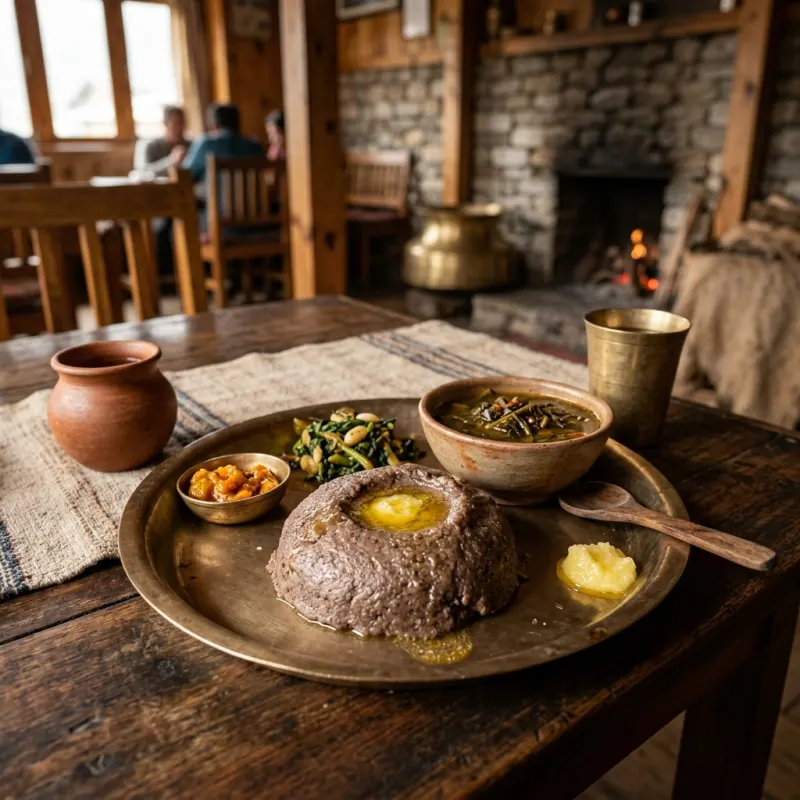
Traditional Nepalese Dhindo porridge with Gundruk soup and yak ghee served on a brass plate

Must Try Dish

Dhindo with Gundruk and Yak Ghee - A traditional Himalayan porridge made by vigorously stirring stone-ground buckwheat or millet flour into boiling water, served alongside tangy fermented leafy-green broth and clarified mountain yak butter.
Food Experiences Title Icon

Food
Experiences

Discover cooking classes, tastings and local food tours

No food experience found
Maya, the human travel expert at TravelingWiz, offering curated, non-AI expertise

Maya’s Final Checklist for Dhunche

Logistics shouldn’t be the focus of your trip—the experience should. I’ve hand-vetted these essential partners to ensure your arrival, stay, and exploration are as smooth as an Athenian breeze.

Where to Stay

From boutique hotels to local apartments—compare thousands of options and find the perfect stay in the best neighborhood.

Air Travel

Getting there should be seamless. Compare the best routes and prices across top airlines to start your journey on the right note.

Local Guides

Connect with experts who know the destination best. Get personalized advice and insider tips to help you plan your perfect trip.

Travel Protection

The “Engineer’s” rule: always have a backup. Secure your trip with a plan that covers every “what if” and unexpected change.

Car Rentals

Explore at your own pace with total freedom. Compare reliable rental options and find the right vehicle for your adventure.

Visa Services

Don’t let paperwork slow you down. Get expert assistance with your application to ensure all your entry documents are in order.

FAQs

Dhunche itself serves as the entry checkpoint for Langtang National Park. Trekkers passing through Dhunche toward Gosainkunda or the Langtang Valley must obtain a Langtang National Park Entry Permit and a TIMS (Trekkers’ Information Management System) card, both verifiable at the army checkpoint in town.
The overland journey covers approximately 118 kilometers along the winding Pasang Lhamu Highway. Due to rugged mountain terrain, narrow unpaved stretches, and heavy truck traffic, the trip typically takes 6 to 9 hours by public bus or 5 to 6 hours by private 4WD jeep.
Dhunche sits at 1,960 meters, which is below the standard threshold where Acute Mountain Sickness typically develops (around 2,500 meters). However, it serves as the crucial staging ground for routes that quickly climb past 4,000 meters toward Gosainkunda, making hydration and restful sleep here vital.

Your Insights Matter

TravelingWiz grows through the stories of our community. If you’ve recently explored ,Dhunche share your tips and stories to help us perfect our guides for the next traveler.

Related Articles

Check out our related articles and blog posts to learn even more about the destination.

No related articles found

Don’t Travel Alone

Share with your friends and family

Where should we send your offline card?

We hate spam just as much as you do

newsletter_consent *