Disclosure: This site contains affiliate links. We may earn a commission if you make a purchase, at no extra cost to you.

Panoramic view of terraced green rice fields in Muong Hoa Valley Sapa Vietnam

Sapa Overview & Key Highlights

Sapa is an alpine market town perched at 1,500 meters above sea level within the Hoang Lien Son mountain range of Northwest Vietnam. Established as a highland retreat during the French colonial era, the town overlooks the dramatic Muong Hoa Valley, famed for its centuries-old sculpted rice terraces and mist-shrouded peaks, including Fansipan, the highest summit in Indochina. Sapa serves as the commercial and cultural crossroads for five distinct ethnic minority groups, predominantly the Black Hmong, Red Dao, and Tay peoples, who maintain their traditional weaving, farming, and social customs across surrounding terraced hamlets. Modern visitors arrive in Sapa seeking world-class valley trekking, immersive rural homestays, and high-altitude mountain vistas. While the central town square features rapid modern hotel development and alpine-inspired architecture, authentic cultural immersion begins immediately upon walking into satellite villages such as Lao Chai, Ta Van, and Ta Phin. Whether ascending Fansipan via modern cable car, sampling herbal medicinal baths prepared by Red Dao herbalists, or hiking along dramatic ridgelines, Sapa presents an exceptional combination of rugged biodiversity and authentic Southeast Asian highland heritage.

Sapa Travel Guide: Logistics & In-Depth Tips

Sapa sits on the roof of Vietnam within Lào Cai Province, commanding sweeping views over the Hoang Lien Son mountain range. First charted as an administrative post and sanatorium by French colonial authorities in the early 1900s due to its cool temperate climate, Sapa has transformed into Southeast Asia's premier trekking capital. The town itself clings to the mountain ridges around a scenic central lake and a French-built stone church dating to 1895, serving as the commercial gateway to the vast agricultural amphitheater of the Muong Hoa Valley below.

Beyond the urban town core, the region's true identity resides in its multi-generational ethnic minority villages. The Black Hmong, known for their indigo-dyed hemp garments and intricate silver jewelry, live alongside the Red Dao, recognized by their vibrant crimson headscarves and extensive herbal medicine traditions. Traversing the contours of hand-carved agricultural terraces built over centuries, travelers encounter a pastoral rhythm of life where water buffalo plow flooded fields and mountain streams power ancient bamboo waterwheels.

Reasons to Visit

  • Hike through the majestic Muong Hoa Valley, home to Southeast Asia's most spectacular cascading rice terraces.
  • Ascend Mount Fansipan at 3,143 meters, celebrated as the 'Roof of Indochina', via modern record-breaking cable car or multi-day guided trek.
  • Experience authentic cultural homestays with Black Hmong and Red Dao families in remote villages like Ta Van and Ta Phin.
  • Rejuvenate fatigued muscles in traditional Red Dao medicinal herb baths infused with rare wild forest botanicals.
  • Shop for genuine handcrafted indigo textiles, beeswax-batik patterns, and silver adornments directly from local artisans.

Things to Avoid

  • Avoid purchasing trinkets or bracelets from young children working in villages, as this encourages school truancy; support adult cooperative workshops instead.
  • Do not photograph village residents, religious shamans, or children without obtaining explicit verbal or gestural permission first.
  • Avoid wearing city sneakers or smooth-soled shoes on mountain hikes, as terrace clay trails become dangerously slick after morning mist.
  • Do not enter sacred spaces or private village altars marked by hung bamboo leaves or protective amulets.
  • Avoid booking unmarked unlicensed motorbikes on steep mountain passes without verifying dual brakes and mountain driving experience.

Local Transportation Tips

Getting around Sapa requires choosing transport suited to rugged terrain. Within Sapa town, walking is practical for reaching the stone church, central market, and lake. For travel into valley villages such as Lao Chai, Ta Van, or Giang Ta Chai, travelers rely on licensed local green taxis, negotiated private 4WD vehicles, or guided motorbikes (xe ôm). Experienced riders can rent semi-automatic scooters for approximately 150,000 VND ($6 USD) per day, though steep gradients, gravel washouts, and thick mountain fog require extreme caution. The Sun World funicular and cable car network provides automated transit between Sapa town, Muong Hoa Valley station, and the summit of Mount Fansipan.

Travel Etiquette

  • Dress modestly with covered shoulders and knees when visiting rural ethnic minority villages and Buddhist temples atop Fansipan.
  • Remove shoes before stepping into the main living quarters of traditional stilt houses or village homestays.
  • Touch door lintels or thresholds with care; never sit with your feet pointed directly toward family ancestral altars.
  • Bargain politely and good-humoredly at craft markets without aggressive haggling over minor sums.
  • Accept food or drink offered by homestay hosts using both hands as a traditional sign of gratitude and respect.

Recommended Age Group

Sapa offers profound natural scenery and cultural heritage, though its steep terrain and physical hiking demands dictate suitability across different age categories.

  • Babies (0-2 years): Not Recommended. Mountain paths are entirely unsuitable for strollers, and sudden temperature fluctuations with damp mountain air can pose health challenges for infants.
  • Kids (3-12 years): Neutral. Children with outdoor endurance will enjoy the cable car ride, rural farm animals, and waterfalls, but standard multi-hour valley treks are overly strenuous for young walkers.
  • Teens (13-19 years): Recommended. Older children and teenagers will thrive during active valley treks, mountain biking, photography expeditions, and peak summit experiences.
  • Adults (20-64 years): Recommended. An optimal destination for hiking enthusiasts, cultural travelers, photographers, and wellness seekers looking for rugged exploration and unique culinary scenes.
  • Seniors (65+ years): Neutral. Highly rewarding for active seniors utilizing the Fansipan cable car, scenic lookouts, and boutique eco-lodges, though uneven cobblestones and steep village trails require good mobility.

Accessibility Level: Medium

  • Sapa presents significant accessibility challenges due to its rugged mountainous topography, steep stone staircases, and uneven village trails.
  • The modern Sun World Fansipan Legend cable car terminal and summit facilities provide elevator access and ramps, allowing wheelchair users to view the high peaks.
  • Central Sapa town features paved sidewalks around the lake, though dropped curbs are inconsistent and often blocked by parked motorbikes.
  • Rural valley paths through rice terraces consist of narrow earthen dikes and natural rock stairs completely inaccessible to wheelchairs or walking aids.
  • Select modern eco-resorts like Topas Ecolodge offer accessible ground-floor bungalows and paved pathways within their private grounds.

Did You Know?

Mount Fansipan's peak rises to 3,143 meters (10,312 feet) above sea level, making it the highest mountain in Vietnam, Laos, and Cambodia combined. Before the world-record three-rope cable car was completed in 2016, reaching the summit required a grueling two-to-three-day technical trek through dense bamboo forests and steep rock gullies.

Cool Statistics

  • 3,143 meters: Elevation of Mount Fansipan, Indochina's tallest mountain peak
  • 5 distinct ethnic minority communities: Black Hmong, Red Dao, Tay, Giay, and Xa Pho living across the district
  • 1,500 meters: Mean altitude of Sapa town above sea level, delivering an alpine microclimate
  • 6,292 meters: Total length of the record-breaking Fansipan three-rope cable car system

Address:

Sapa, Vietnam

Find Nearby Accommodations

Basic Info

address icon

COUNTRY & Region

Vietnam,
Asia

ACCESSIBILITY LEVEL​

Medium
Currency icon

LOCAL CURRENCY​

Vietnamese Dong (VND)
Price level icon
Low
Safety Level icon

SAFETY LEVEL

Duration icon

Recommended Duration

• 1-7 days

Electricity

electricity icon

Electricity

220-240V, 
50Hz
Plug Socket icon

Plug Type

• Type A (Flat blade)
• Type C (Round pin)
Plug types
Click To View Plug Types
Sapa is part of our
Coolcation collection

Activities To Do In Sapa

Best Time To Visit Sapa

Sapa experiences four distinct seasons shaped by its subtropical highland climate. The most visually striking times to visit are spring and early autumn, while winter brings severe cold fog and summer introduces monsoon rains.

  • March to May (Spring): Clear, dry weather with blooming peach and plum orchards; daytime temperatures range between 15°C and 22°C (59°F–72°F).
  • June to August (Summer): Lush green terraces with active planting; warm and humid with frequent heavy afternoon rain showers (20°C–27°C / 68°F–81°F).
  • September to October (Harvest Season): Golden rice terraces ready for harvest, optimal trekking conditions, and crisp sunny days (15°C–23°C / 59°F–73°F).
  • November to February (Winter): Cold, foggy, and damp with occasional mountain frost or summit flurries; temperatures often dip below 5°C (41°F).

Average Temperatures Per Month

Remember to check the weather forecast a few days before the trip and before heading to the airport.

Safety Level icon

Safety Level

Sapa is very peaceful with exceptionally low violent crime rates. The primary safety concerns are environmental hazards such as extremely slick mud paths along vertical terrace drops and unstable motorbikes on winding mountain passes. Wear appropriate footwear with deep tread to prevent serious falls. In town, decline aggressive street solicitation from persistent handicraft vendors with a polite, firm smile. During winter months, check for room heating before booking, as uninsulated mountain lodges can become dangerously cold overnight.

The rating is based on multi-year peace, crime, and security indices. Before you go, always verify current conditions through official government travel advisories.

Emergency Numbers

Police: 113
Ambulance: 115

No internet needed • Includes local translations • Free for TravelingWiz readers

Spoken Languages

Vietnamese is the official national language. Regional ethnic minority languages including Hmong, Dao, and Tay are spoken in local households. Basic to intermediate English is widely spoken by hotel staff, trekking guides, and younger shopkeepers in Sapa town.

Learn The Language

  • Xin chào – Hello
  • Cảm ơn – Thank you
  • Làm ơn – Please
  • Bao nhiêu tiền? – How much does this cost?
  • Vâng / Không – Yes / No
  • Tôi muốn đi… – I want to go to…
  • Ngon quá! – Delicious!
  • Tạm biệt – Goodbye
Travel Booking Partner - TravelingWiz

Trip Cost & Budgeting for Sapa, 2026

Everything you need to know about money while traveling
Sapa remains an exceptionally affordable highland destination where travel funds stretch remarkably far for lodging, guided hikes, and mountain cuisine. With TravelingWiz's Human Verified data, a typical traveler should expect to spend around $55 USD per day for a mid-range trip. Modest daily expenses include roughly $1.50 USD for a traditional drip coffee or local herbal tea, and around $6 to $10 USD for a hearty multi-dish dinner in a village homestay. Click the Trip Cost Calculator button below the table to work out your personal budget for this trip.
Currency icon

LOCAL CURRENCY​:

Vietnamese Dong (VND)
Price level icon
Low
Cash is mandatory across Sapa's outer villages, local markets, and family homestays. While high-end hotels and modern restaurants in Sapa town center accept major credit cards (Visa and Mastercard), foreign cards incur a standard 3% transaction surcharge. ATMs from banks such as Agribank, BIDV, and Vietcombank are clustered around Sapa central square, but village ATMs do not exist. Always withdraw sufficient Vietnamese Dong before embarking on multi-day treks.

Per person, per day – pocket cash for small purchases.

Local: 750000
Vietnamese Dong (VND)
≈ 30 USD

Full daily spend estimation (accommodation, food, transportation, attractions).

Travel Style
Vietnamese Dong (VND)
≈ USD ($)
Budget
625000
25
Mid-range
1375000
55
Comfort
3000000
120

The Prices, Daily costs, and calculator results are estimates for planning purposes only. Actual costs may vary based on season, booking timing, personal spending habits, and currency fluctuations. TravelingWiz cannot be held responsible for discrepancies between these estimates and your final trip expenses.

  • Book overnight sleeper trains from Hanoi to Lao Cai instead of private vans to combine transit and accommodation costs seamlessly.
  • Hire local community-based village guides directly in Ta Van or Lao Chai rather than booking marked-up packages through central Hanoi agencies.
  • Opt for family-run homestays in the Muong Hoa Valley; meals are included or cost-effective and provide superior cultural insight compared to town-center hotels.
  • Skip the multi-tier mountain train packages on Fansipan if you are physically fit; take the main cable car and walk the final summit stone steps.
  • Eat locally at Sapa Market for regional specialties like smoked buffalo meat and pumpkin stem stir-fry at standard local rates.

Pre-Order Tickets

Avoid disappointment when tickets sell out — and skip the long lines by booking online in advance. You’ll often save up to 20% too.
Save up to 20%

Travel Discounts & Coupons

Save on hotels, attractions, transport, and gear — find verified discounts for smarter travel spending.
Verified Coupons

What To Pack

  • Sturdy broken-in hiking boots or trail running shoes with aggressive tread for slippery mountain trails
  • Lightweight waterproof rain jacket and pack cover, essential for sudden highland cloudbursts
  • Layered clothing including thermal base layers, fleece jacket, and breathable moisture-wicking shirts
  • Trekking poles to navigate steep, muddy terrace descents safely
  • Small denominations of Vietnamese Dong cash for village entry fees and artisan purchases
  • High-SPF sunscreen, polarized sunglasses, and a wide-brim hat for intense high-altitude UV rays
  • Insect repellent containing DEET or picaridin for lower valley forest treks
  • Quick-dry travel towel and flip-flops for rustic village homestay visits
We couldn't find tips for Sapa.
If you got any, please share

Recommended Itineraries for Traveling to Sapa

We couldn't find itineraries for Sapa.
you can contact us for custom trip plan

Food & Drink Highlights

Local Food Overview

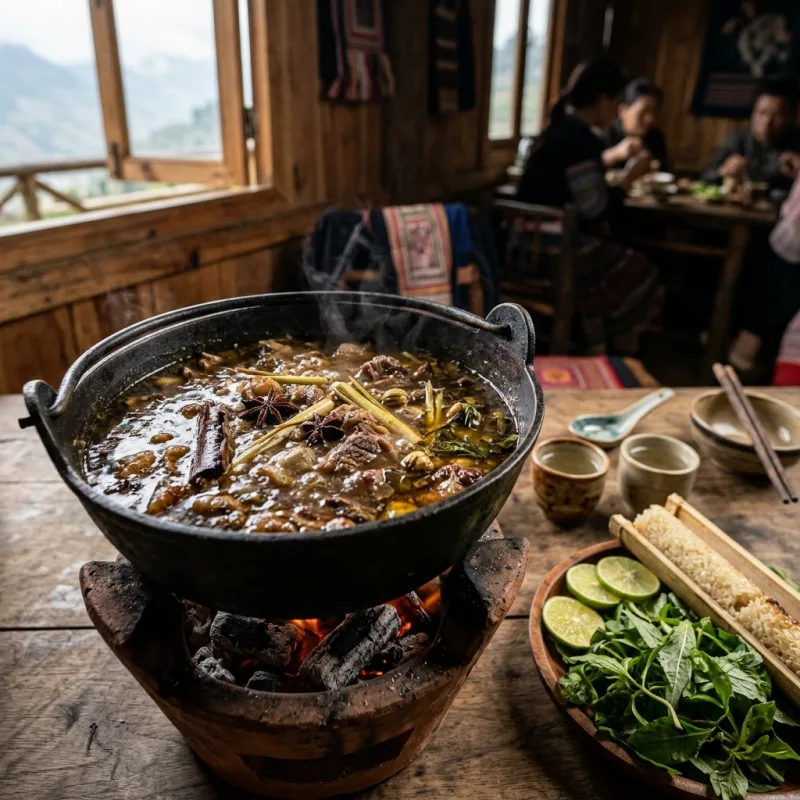
Sapa's high-altitude terroir and cool mountain temperatures shape a distinctive culinary tradition that sets it apart from lowland Vietnamese cuisine. Forest herbs, wild mountain vegetables, cold-water fish, and hearty broths dominate the local menu. Black Hmong and Red Dao communities prepare dishes designed to sustain agricultural labor and withstand winter cold, featuring ingredients such as black chicken (gà đen), chayote greens (ngọn su su), and locally farmed salmon and sturgeon reared in frigid mountain springs. Barbecue stalls line the night market streets, grilling skewers of seasoned wild pork, bamboo-tube sticky rice (cơm lam), and wild mushrooms over charcoal braziers.
Authentic Thang Co mountain stew served family style in Sapa Vietnam

Must Try Dish

Thắng Cố (Highland Horse Meat Hotpot) - This legendary Hmong stew combines cuts of horse meat and offal simmered for hours with over twenty wild mountain herbs including star anise, cardamom, and lemongrass. Eaten family-style alongside fresh mountain greens and corn wine, the dish delivers an earthy, warming complexity unique to northwestern Vietnam.
Food Experiences Title Icon

Food
Experiences

Discover cooking classes, tastings and local food tours

No food experience found
Maya, the human travel expert at TravelingWiz, offering curated, non-AI expertise

Maya’s Final Checklist for Sapa

Logistics shouldn’t be the focus of your trip—the experience should. I’ve hand-vetted these essential partners to ensure your arrival, stay, and exploration are as smooth as an Athenian breeze.

Where to Stay

From boutique hotels to local apartments—compare thousands of options and find the perfect stay in the best neighborhood.

Air Travel

Getting there should be seamless. Compare the best routes and prices across top airlines to start your journey on the right note.

Local Guides

Connect with experts who know the destination best. Get personalized advice and insider tips to help you plan your perfect trip.

Travel Protection

The “Engineer’s” rule: always have a backup. Secure your trip with a plan that covers every “what if” and unexpected change.

Car Rentals

Explore at your own pace with total freedom. Compare reliable rental options and find the right vehicle for your adventure.

Visa Services

Don’t let paperwork slow you down. Get expert assistance with your application to ensure all your entry documents are in order.

FAQs

Travelers typically choose between an 8-hour overnight sleeper train from Hanoi Railway Station to Lao Cai followed by a 50-minute mountain shuttle van, or a direct luxury limousine bus via the Hanoi-Lao Cai expressway taking approximately 5.5 to 6 hours.
While short walks around Cat Cat village or Ham Rong mountain are self-navigable, hiring a local ethnic minority guide is strongly recommended for rural treks through the Muong Hoa Valley, Ta Van, and Ban Ho due to unmarked trails and private agricultural boundaries.
Yes, the Sun World Fansipan Legend cable car runs daily throughout the year, though operations may pause briefly during extreme high winds, severe thunderstorms, or scheduled seasonal maintenance in late winter.
Mid-September to early October is the peak harvest window when the terraced paddies turn vibrant gold before farmers begin cutting the grain.

Your Insights Matter

TravelingWiz grows through the stories of our community. If you’ve recently explored ,Sapa share your tips and stories to help us perfect our guides for the next traveler.

Related Articles

Check out our related articles and blog posts to learn even more about the destination.

No related articles found

Don’t Travel Alone

Share with your friends and family

Where should we send your offline card?

We hate spam just as much as you do

newsletter_consent *