Stretching along a narrow strip of land between the Adriatic Sea and the Slovenian border, the Province of Trieste is one of Italy's most culturally distinct destinations. As the principal seaport of the Austro-Hungarian Empire for centuries, the regional capital boasts magnificent neoclassical architecture, wide avenues, and majestic sea-facing piazzas that stand in stark contrast to typical Italian medieval centers.
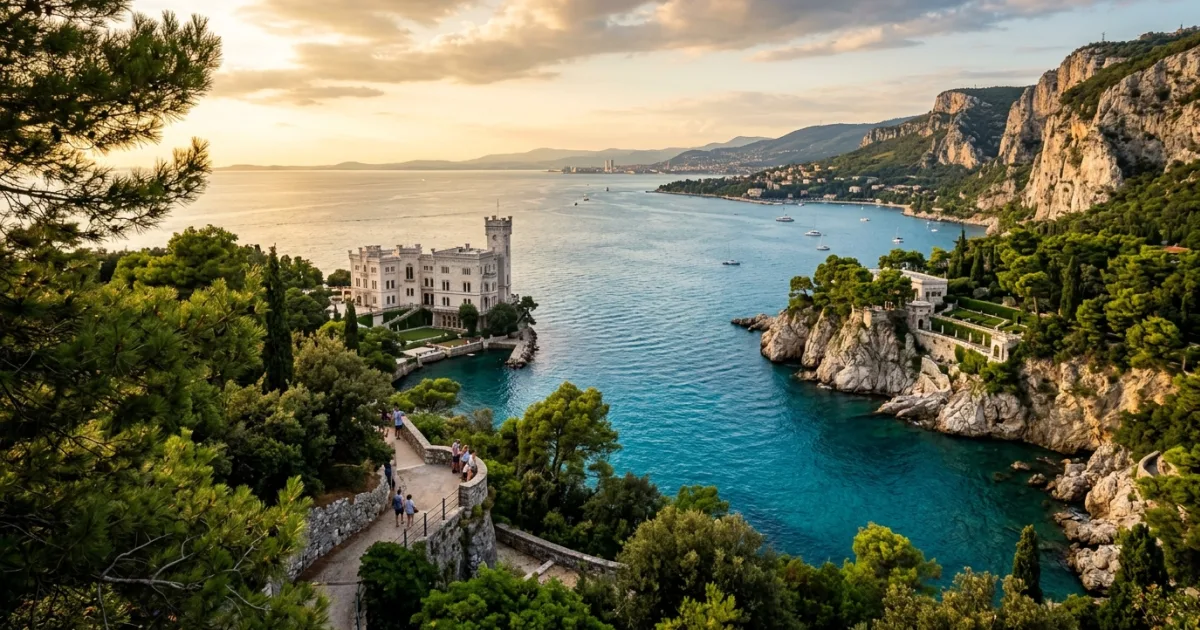
Surrounding the urban hub is the Karst (Carso) plateau, a rugged limestone formation dotted with subterranean grottos, sinkholes, and resilient vineyards. The natural drama peaks at high coastal cliffs where historic fortresses like Duino Castle and Miramare Castle overlook azure waters. Combining multicultural intellectual traditions, vibrant maritime activities, and distinct Austro-Slavic gastronomy, the province provides an exceptional coastal and cultural retreat.
Reasons to Visit
- Explore Miramare Castle, the 19th-century imperial residence set dramatically on a promontory above a protected marine reserve.
- Experience Piazza Unità d'Italia, the largest sea-facing public square in Europe.
- Descend into Grotta Gigante, one of the world's largest show caves accessible to tourists.
- Immerse yourself in authentic literary café culture frequented by James Joyce, Italo Svevo, and Umberto Saba.
- Sample indigenous Vitovska and Terrano wines at traditional Karst osmize along country backroads.
Things to Avoid
- Avoid ordering coffee without knowing the local lexicon; asking for a standard 'caffè latte' or 'cappuccino' will often result in a drink different from what you expect.
- Do not ignore Bora wind warnings; avoid walking near unsecured scaffolding or on steep coastal cliffs during peak gusts.
- Avoid staying solely in downtown Trieste—venture out to Muggia's Venetian harbor and the Karst plateau nature reserves.
- Do not rely entirely on credit cards when heading into small village osmize up in the hills.
Local Transportation Tips
The province boasts a comprehensive public transport network operated by TPL FVG. Urban buses connect all neighborhoods of Trieste with suburban villages, Miramare Castle, and the Karst plateau. The historic Delfino Verde passenger ferry operates seasonal routes connecting Trieste, Barcola, Grignano, and the Venetian-style port of Muggia, offering scenic alternatives to road travel.
Travel Etiquette
- Address shopkeepers and waitstaff with a polite 'Buongiorno' or 'Buonasera' upon entering an establishment.
- When visiting an osmiza, seat yourself at shared wooden trestle benches respectfully alongside locals.
- Dress smartly and respectfully when entering historic religious buildings such as the Cathedral of San Giusto and the Serbian Orthodox Temple of Saint Spyridon.
- Tipping is discretionary in restaurants; a small round-up or 5-10% for attentive service is appreciated but not mandatory.
Recommended Age Group
The Province of Trieste offers versatile cultural and outdoor activities tailored across multiple generations.
- Babies (0-2 years): Neutral. The flat sea promenade and grand piazzas are stroller-friendly, but Karst cliff paths, ancient castles, and subterranean caves feature steep steps and rugged surfaces.
- Kids (3-12 years): Recommended. Children will love exploring the immense Grotta Gigante cavern, the fairy-tale towers of Miramare Castle, and calm sea swimming at Sistiana bay.
- Teens (13-19 years): Recommended. Offers windsurfing, sailing, coastal snorkeling, and atmospheric historic trails along with lively seaside promenades.
- Adults (20-64 years): Recommended. Perfect balance of world-class coffee culture, wine tasting in the Karst, literary history, fine dining, and coastal hiking.
- Seniors (65+ years): Recommended. Highly accessible downtown squares, comfortable sea promenades, rich museums, and relaxed culinary traditions make it deeply rewarding.
Accessibility Level: Medium
- Downtown Trieste features wide, flat pavements, ramped pedestrian crossings, and step-free access around Piazza Unità d'Italia and the Canal Grande.
- Miramare Castle's ground-floor rooms and surrounding botanical gardens offer paved accessible routes, though some uphill paths require assistance.
- Grotta Gigante contains several hundred steps and is not wheelchair accessible; however, its visitor center features a 3D virtual tour.
- Local city buses feature low-floor boarding and dedicated spaces for travelers using wheelchairs.
Did You Know?
Piazza Unità d'Italia in Trieste is the largest seaside square in Europe, and during the annual Barcolana regatta in October, over 2,000 sailing vessels crowd the gulf right in front of it, making it the largest sailing regatta in the world.
Cool Statistics
- Over 2,000 sailing vessels participate in the province's annual Barcolana regatta.
- The Grotta Gigante's central hall reaches an astounding height of over 107 meters (351 feet).
- Trieste handles approximately one-third of Italy's entire green coffee imports annually.






Buy a compatible power adapter for your trip