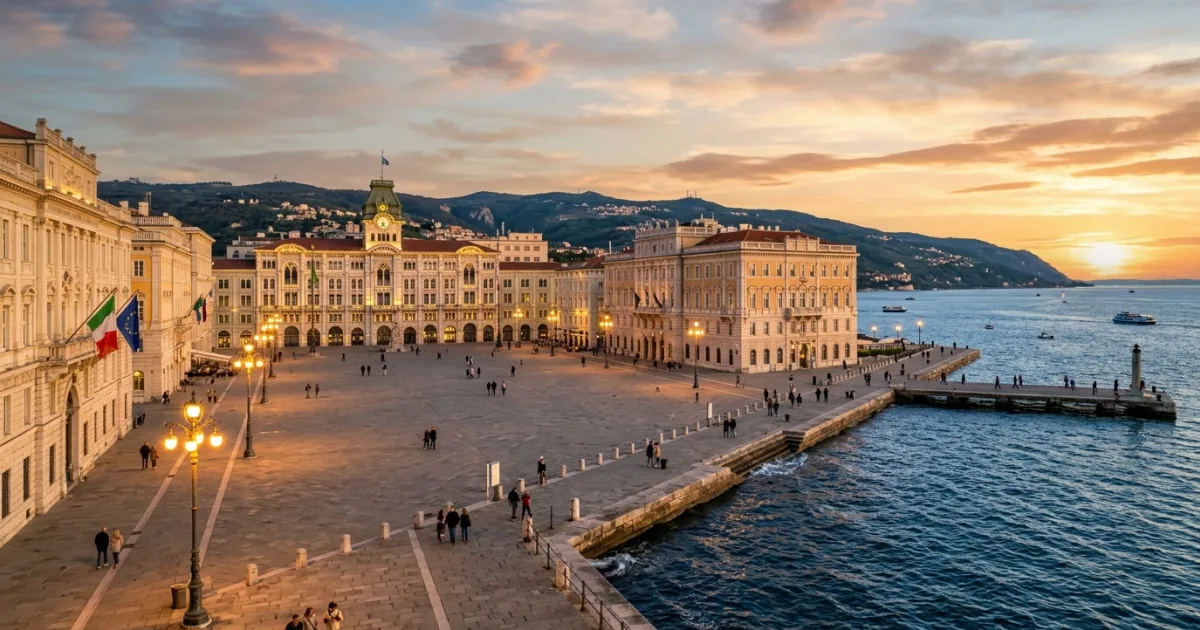
Trieste is geographically secluded on a narrow coastal strip wedged between the blue Adriatic Sea and the limestone rim of the Slovenian Karst. For more than five centuries, it served as the commercial maritime gateway for the Austrian Habsburg Empire. This distinctive heritage endows the city with grand, broad boulevards, neoclassical facades, and monumental civic architecture far more reminiscent of Vienna or Budapest than Rome or Florence.
Beyond its imperial core, Trieste is defined by its deep maritime identity and vibrant literary history. Writers such as James Joyce, who resided here for over a decade, found creative haven in the city's lively harbor taverns and elegant coffee salons like Caffè San Marco and Caffè degli Specchi. Modern Trieste maintains a tranquil coastal elegance, serving as a hub for scientific research, international sailing regattas, and an unmatched crossroads of Mediterranean and Central European gastronomy.
Reasons to Visit
- Marvel at Piazza Unità d'Italia, the grandest sea-facing public square in Europe.
- Tour the fairy-tale white limestone walls and lush cliffside gardens of Miramare Castle.
- Indulge in historic literary café culture where famous 20th-century authors penned masterpieces.
- Explore the Roman Theatre ruins and the medieval San Giusto Cathedral perched atop the hill.
- Experience an authentic 'osmiza' dining experience in the Karst plateau, tasting artisanal prosciutto and Terrano wine.
Things to Avoid
- Do not order an espresso using standard Italian phrases in traditional cafes; remember that 'un nero' is an espresso and 'un capo in b' is an espresso macchiato in a glass.
- Avoid standing too close to exposed seawalls or pier edges along the Molo Audace when Bora wind warnings are in effect.
- Do not expect sandy resort beaches; Trieste locals sunbathe on stone platforms and pebbles along the Barcola promenade or at Bagno Marino La Lanterna (Pedocin).
- Avoid rushing through the city on a quick day trip; its relaxed cultural layers require at least two to three days to appreciate.
Local Transportation Tips
Trieste is served by an efficient municipal bus network operated by Trieste Trasporti. Single tickets and day passes must be purchased at tabaccherie or through transit smartphone apps before boarding. The city center is compact and best explored on foot, though buses link downtown effortlessly to outer attractions like Miramare Castle (Bus 6) and the Karst plateau. Taxis are reliable and can be hailed at designated ranks across central piazzas.
Travel Etiquette
- When greeting shopkeepers or café staff, use 'Buongiorno' or 'Buonasera' rather than informal greetings like 'ciao'.
- Dress appropriately when entering churches such as the Cathedral of San Giusto; ensure shoulders and knees are covered.
- Understand that in historic cafés, sitting at a table with table service incurs a higher cover charge than drinking at the counter.
Recommended Age Group
Trieste is a sophisticated, walkable destination with wide pedestrian promenades and leisurely cultural attractions suited for multiple demographics.
- Babies (0-2 years): Neutral. The flat seaside promenade and Piazza Unità d'Italia are stroller-friendly, though uphill routes to San Giusto castle involve cobblestones and steps.
- Kids (3-12 years): Neutral. Children enjoy the maritime views, castle towers, and the nearby Grotta Gigante cave, though the city focuses heavily on architecture and historic cafes rather than theme parks.
- Teens (13-19 years): Recommended. Teenagers appreciate coastal swimming at Barcola, water sports, vibrant shopping streets, and the dramatic subterranean scenery of the Karst caves.
- Adults (20-64 years): Recommended. An outstanding destination for lovers of literature, architecture, sailing, wine tasting, and refined European café culture.
- Seniors (65+ years): Recommended. Excellent flat pedestrian zones along the sea, accessible public transit, a calm pace of life, and top-tier safety.
Accessibility Level: Medium
- The core city center, Borgo Teresiano, and the seafront promenades around Piazza Unità d'Italia are predominantly flat and wheelchair accessible.
- Modern public buses operated by Trieste Trasporti feature low-floor boarding ramps and dedicated wheelchair spaces.
- Miramare Castle offers elevator access to primary historic apartments, though some steep exterior park trails present gravel challenges.
- Hilltop sights such as the San Giusto Castle and Cathedral require private transport or designated buses to bypass steep cobblestone inclines.
Did You Know?
Bagno Marino La Lanterna, locally nicknamed 'Pedocin', is one of the last remaining seaside bathing establishments in Europe that maintains a physical wall separating men and women, a tradition dating back to 1903 under Austro-Hungarian rule that locals deliberately chose to preserve.
Cool Statistics
- Piazza Unità d'Italia spans more than 12,000 square meters, making it Europe's largest public square opening directly onto the sea.
- Trieste imports over one-third of Italy's raw coffee beans, processing them through its specialized commercial port.
- The annual Barcolana regatta, hosted in the Gulf of Trieste, is recognized by Guinness World Records as the largest sailing race on Earth, with over 2,000 competing vessels.






Buy a compatible power adapter for your trip