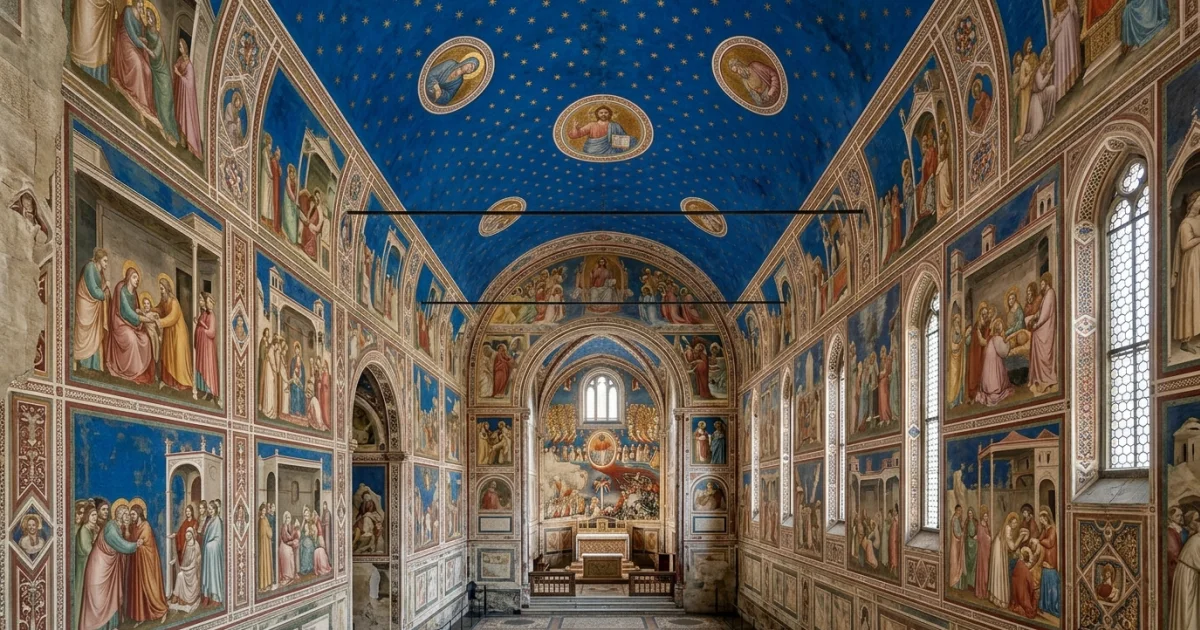
The Scrovegni Chapel is a modest brick building from the outside, belying the breathtaking explosion of color and narrative genius within. Giotto di Bondone, considered the father of the Renaissance, was commissioned to paint the interior in 1303. Over the course of roughly 850 days, he created a cycle of 38 scenes depicting the Life of the Virgin and the Life of Christ, arranged in three horizontal bands. The lower register features striking monochrome allegories of the Vices and Virtues, leading the eye toward the monumental Last Judgment on the counter-facade.
What makes the Scrovegni Chapel a turning point in art history is Giotto's departure from the flat, stylized figures of Byzantine art. He introduced three-dimensional volume, naturalistic expressions, and a profound sense of human emotion. The figures in the 'Lamentation of Christ,' for example, display raw, palpable grief. The entire cycle is unified by a brilliant lapis lazuli blue ceiling, studded with golden stars, which creates an immersive, celestial atmosphere that continues to captivate visitors over 700 years later.
Reasons to Visit
- Witness the birthplace of Renaissance painting and Giotto's revolutionary use of perspective and emotion.
- Experience a UNESCO World Heritage site, recognized as part of Padua's 14th-century fresco cycles.
- Marvel at the incredibly preserved lapis lazuli blue ceiling and vibrant pigments.
- Enjoy the intimate, highly controlled viewing environment that ensures an uncrowded experience.
- Explore the adjacent Eremitani Civic Museums, included in the ticket price.
Things to Avoid
- Do not arrive late. If you miss your designated acclimatization time slot, you will be denied entry without a refund.
- Avoid bringing large bags, backpacks, or umbrellas, as they must be checked in the cloakroom and can delay your entry.
- Do not touch the walls or lean on any surfaces inside the chapel.
- Avoid using flash photography, which is strictly forbidden and monitored by staff.
Local Transportation Tips
The Scrovegni Chapel is easily accessible via Padua's public transportation network. The city's modern tram system (SIR 1) stops at 'Eremitani,' which is just a short walk from the chapel entrance. If arriving by train at Padova Centrale, the chapel is a pleasant 10-15 minute walk south along Corso del Popolo. Taxis are also readily available at the station, and the city center is highly walkable and pedestrian-friendly.
Travel Etiquette
- Maintain absolute silence or speak in very hushed whispers while inside the chapel to respect the atmosphere and other visitors.
- Follow all instructions from the museum staff, especially regarding the timing of entering and exiting the acclimatization chamber and the chapel.
- Dress respectfully, as it is a former consecrated religious site, though strict dress codes are rarely enforced for the museum.
- Be mindful of other visitors' space during the short 15-minute viewing window.
Recommended Age Group
The Scrovegni Chapel offers a profound historical and visual experience, though its strict rules and short duration cater differently to various age groups.
- Babies (0-2 years): Neutral. While allowed, the strict silence required and the 15-minute wait in the glass chamber can be challenging for restless infants.
- Kids (3-12 years): Recommended. The vibrant colors, starry ceiling, and clear narrative stories (like a giant comic book) can be very engaging for children, and the 15-minute viewing time is perfectly suited to short attention spans.
- Teens (13-19 years): Recommended. An excellent, bite-sized educational experience that brings art history and the Renaissance to life without being overly long or tedious.
- Adults (20-64 years): Recommended. A must-see for art lovers, history buffs, and anyone appreciating cultural heritage.
- Seniors (65+ years): Recommended. The site is highly accessible, requires minimal walking once inside the complex, and offers a comfortable, climate-controlled environment.
Accessibility Level: Medium
- The Scrovegni Chapel and the acclimatization chamber are fully accessible to wheelchair users.
- Ramps and elevators are available to navigate the slight elevation changes from the ticket office to the chapel entrance.
- Accessible restrooms are located in the adjacent Eremitani Museum complex.
- Service animals are generally permitted, but it is advised to contact the museum in advance to confirm specific requirements.
Did You Know?
Enrico Scrovegni commissioned the chapel largely to expiate the sins of his father, Reginaldo, who was a notorious usurer (moneylender). Usury was considered a grave sin by the Church. In the massive Last Judgment fresco above the exit, Giotto painted Enrico Scrovegni himself, kneeling and offering a model of the chapel to the Virgin Mary, symbolically securing his own salvation.
Cool Statistics
- The fresco cycle covers approximately 900 square meters of wall space.
- Giotto completed the entire masterpiece in roughly 852 'giornate' (a day's work of fresco painting).
- The chapel was acquired by the City of Padua in 1880 to save it from neglect and potential destruction.
- Visitors are kept in the acclimatization chamber for exactly 15 minutes to stabilize the microclimate before entering.






Buy a compatible power adapter for your trip