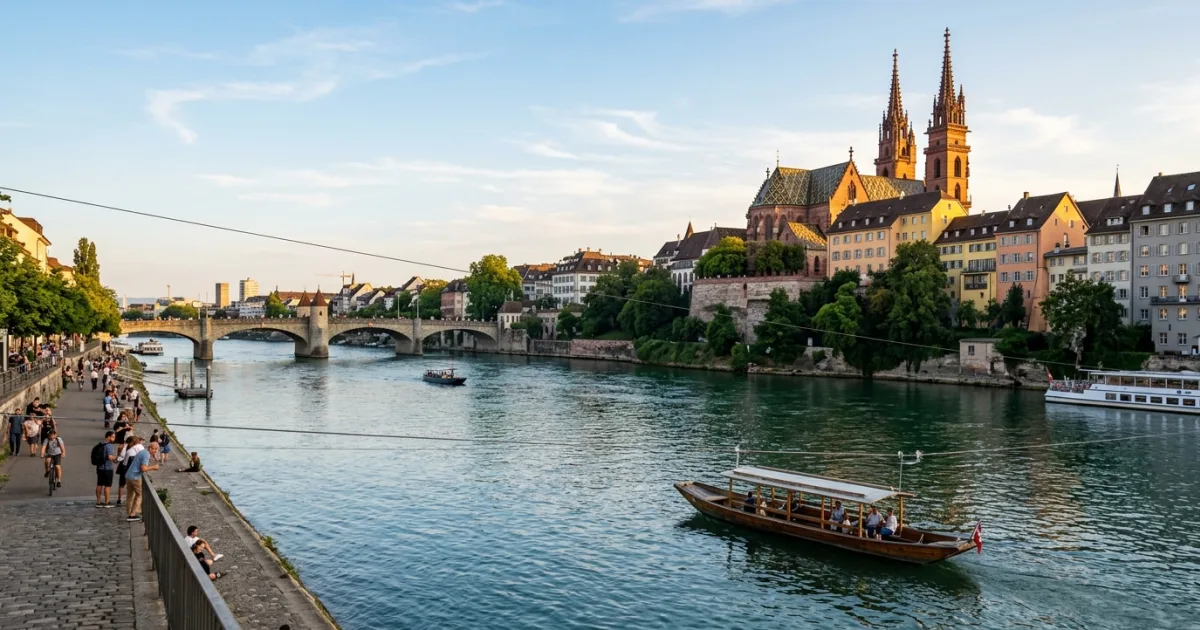
Altstadt Basel embodies more than two millennia of cultural exchange at the head of the navigable Rhine River. Once a prominent Roman settlement and later an influential prince-bishopric, the historic district retains its dense urban fabric shaped during the Middle Ages. Its two distinct sections—Grossbasel perched on the high southern bank and Kleinbasel settled along the northern waterfront—are tied together by the storied Mittlere Brücke, first erected in 1226.
Today, the Old Town serves as both an architectural open-air museum and an active community hub. Prominent sights like the bright red Rathaus on Marktplatz host daily regional markets, while the serene cloisters of the Basler Münster provide sweeping vistas of the Black Forest and neighboring Alsace. Car-free avenues, well-curated antique shops, and century-old guild halls make Altstadt Basel one of the most delightful cultural quarters in Central Europe.
Reasons to Visit
- Marvel at the Gothic architecture, Romanesque carvings, and Erasmus's tomb inside the majestic Basler Münster.
- Stroll through the picturesque Spalenberg neighborhood filled with independent boutiques, galleries, and preserved timber facades.
- Glide across the Rhine River aboard traditional unmotorized Fähri ferries tethered to overhead steel cables.
- Photograph the vibrant crimson façade and gilded decorations of the 500-year-old Rathaus (Town Hall).
- Access world-leading cultural institutions including the Kunstmuseum Basel within minutes on foot.
Things to Avoid
- Avoid wearing thin high heels or rigid-soled shoes, as the historic cobblestone streets can cause foot fatigue or tripping.
- Do not pay for city tram tickets before checking into your hotel, since your reservation confirmation functions as a free transit pass to your accommodation.
- Avoid jumping into the Rhine for a swim from Grossbasel; the safe swimming areas and exit points are situated along the Kleinbasel shore.
- Do not ignore quiet hours in residential courtyards and cathedral cloisters, which remain strictly observed sacred and living spaces.
Local Transportation Tips
Altstadt Basel is comprehensively connected by Basel's clean and efficient green tram system (BVB), with Barfüsserplatz, Marktplatz, and Schifflände serving as key transit hubs. The inner core is largely vehicle-free, making walking the primary and most enjoyable method of travel. Rhine crossings are facilitated either via the central pedestrian bridge Mittlere Brücke or through four historical reaction ferries (Fähri) that glide across the river without engines.
Travel Etiquette
- Greet shopkeepers and restaurant staff with a polite 'Grüezi' upon entry and 'Adieu' when departing.
- Respect recycling rules by separating paper, glass, and aluminum at designated city waste receptacles.
- Keep right on escalators and allow passengers to exit trams completely before boarding.
- Maintain low noise levels in public squares after 22:00 to honor Swiss quiet-hour standards.
Recommended Age Group
Altstadt Basel provides engaging historical and cultural experiences across multiple age categories, particularly favoring self-paced walkers.
- Babies (0-2 years): Neutral. Cobblestone streets and stepped alleys around Spalenberg present minor challenges for standard strollers, though baby carriers work well.
- Kids (3-12 years): Recommended. Interactive reaction ferry rides across the Rhine, expansive riverfront parks, and whimsical fountains like the Tinguely Fountain delight young travelers.
- Teens (13-19 years): Recommended. Trendy shops in Kleinbasel, Rhine river swimming in summer, and world-class modern art collections appeal strongly to teenagers.
- Adults (20-64 years): Recommended. Ideal for architecture lovers, museum enthusiasts, culinary travelers, and history enthusiasts seeking walkable European charm.
- Seniors (65+ years): Recommended. Excellent public transit connections, frequent tram service, numerous resting benches, and gentle terrain along the riverbank offer exceptional comfort.
Accessibility Level: Medium
- Many primary thoroughfares including Freie Strasse and Marktplatz feature smooth stone walkways and level tram boarding platforms.
- Steep cobblestone inclines connecting lower streets to Münsterplatz can require extra effort for manual wheelchair users.
- Key landmarks such as the Basler Münster and Kunstmuseum offer step-free ramp access and dedicated elevators.
- Public accessible restrooms equipped with Eurokey access are distributed throughout central transit squares.
Did You Know?
The historic Rhine reaction ferries (Fähri) that connect Grossbasel and Kleinbasel have operated for over 150 years without an engine, relying purely on a steel overhead cable and the natural kinetic energy of the river's current to drift across.
Cool Statistics
- Over 40 museums sit within or directly adjacent to Basel's compact Old Town borders.
- The iconic Mittlere Brücke has stood as a Rhine crossing point since its initial construction in 1226.
- The Basler Münster's prominent twin towers, Georgsturm and Martinsturm, reach heights of over 62 meters.






Buy a compatible power adapter for your trip