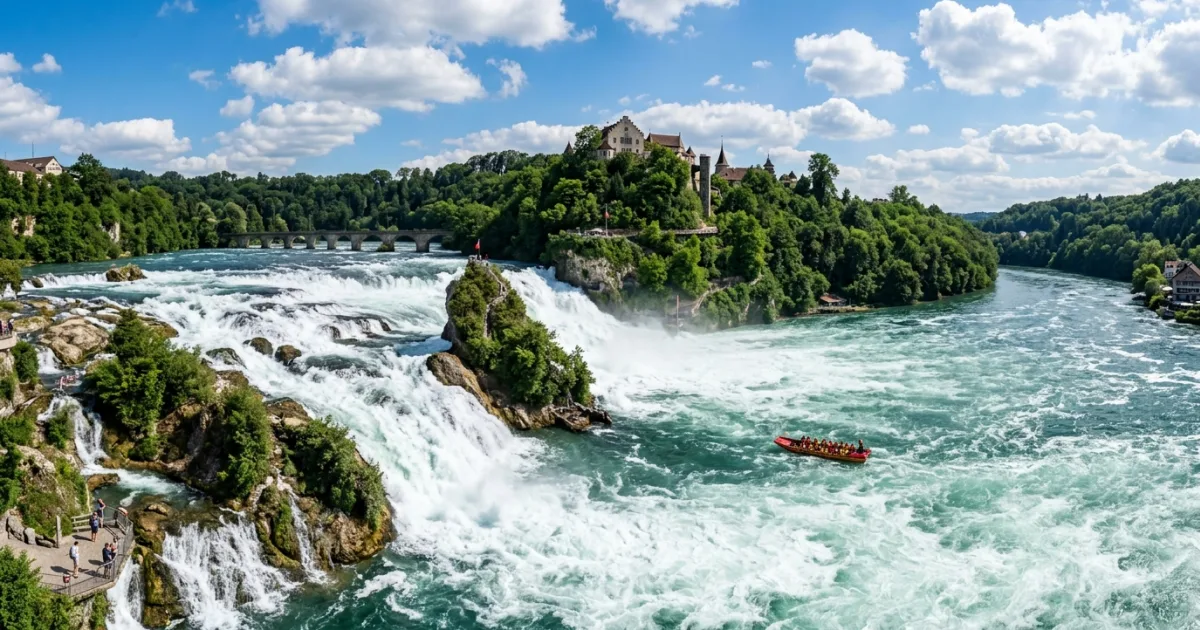
Formed during the last ice age over 15,000 years ago, the Rhine Falls stand as a testament to the enduring power of nature. The falls are located on the High Rhine, where tectonic shifts forced the river into a new riverbed, creating the dramatic drop seen today. The sheer volume of water is staggering, with an average summer flow of 600 cubic meters per second crashing over the limestone rocks.
Beyond the falls themselves, the surrounding area is steeped in history. Schloss Laufen, perched on a cliff directly above the roaring waters, dates back over a thousand years and now houses a visitor center, restaurant, and access to the closest viewing platforms. On the opposite bank, the Schlössli Wörth serves as the departure point for the iconic boat tours that have been thrilling visitors for decades.
Reasons to Visit
- Witness the sheer power and scale of Europe's largest waterfall.
- Take a thrilling boat ride that drops you off at the rock in the center of the falls.
- Explore the historic Laufen Castle and its panoramic glass elevator.
- Enjoy well-maintained hiking trails along the scenic Rhine riverbanks.
- Experience the spectacular evening illuminations of the falls (during select seasons).
Things to Avoid
- Avoid visiting in the dead of winter if you want to experience the boat tours, as they are closed.
- Don't forget a waterproof layer; the mist from the falls will get you wet on the viewing platforms.
- Avoid driving right up to the falls during peak summer weekends; use the excellent train connections instead to bypass parking issues.
- Don't ignore the safety barriers; the currents are incredibly strong and dangerous.
Local Transportation Tips
The Rhine Falls area is exceptionally well-connected by the Swiss Federal Railways (SBB). There are two dedicated train stations right at the falls: 'Neuhausen Rheinfall' on the northern bank and 'Schloss Laufen am Rheinfall' on the southern bank. Both offer frequent connections to Zurich, Schaffhausen, and Winterthur.
For getting between the northern and southern banks, a pedestrian bridge runs alongside the railway bridge above the falls, offering a scenic 15-minute walk. Alternatively, during the summer months, a small ferry boat shuttles visitors across the river basin.
Travel Etiquette
- Respect the natural environment by staying on marked paths and disposing of trash in designated bins.
- Keep noise levels reasonable, especially in the early morning or late evening, to respect local residents.
- When taking photos on the narrow viewing platforms, be mindful of others waiting for their turn.
- Tipping in restaurants is not strictly required as a service charge is included, but rounding up the bill is appreciated for good service.
Recommended Age Group
Rhine Falls offers a spectacular and accessible experience for visitors of all ages, with excellent infrastructure catering to everyone from toddlers to seniors.
- Babies (0-2 years): Recommended. The northern bank is highly stroller-friendly, though baby carriers are better for the steep stairs at Laufen Castle.
- Kids (3-12 years): Recommended. Children will be thrilled by the boat rides and the nearby Adventure Park (Rheinfallpark) with its high-ropes courses.
- Teens (13-19 years): Recommended. The sheer power of the falls provides great photo opportunities, and the adventure park offers active engagement.
- Adults (20-64 years): Recommended. Perfect for photography, hiking the surrounding trails, and enjoying regional cuisine with a view.
- Seniors (65+ years): Recommended. The site features a glass elevator at Laufen Castle and paved paths on the northern bank, making it highly accessible for those with limited mobility.
Accessibility Level: Medium
- The northern bank (Neuhausen side) features paved, flat paths that are fully wheelchair and stroller accessible.
- Schloss Laufen on the southern bank is equipped with a glass elevator that provides barrier-free access to the main viewing platform.
- Accessible restrooms are available at both the visitor center at Schloss Laufen and near Schlössli Wörth.
- Note that the boat tours and the central rock climb involve stairs and uneven surfaces, which are not wheelchair accessible.
Did You Know?
Despite the massive volume of water, fish cannot swim up the Rhine Falls. The only exception is the eel, which manages to bypass the falls by wriggling its way up over the wet rocks along the edges.
The famous painter J.M.W. Turner visited the Rhine Falls in the 19th century and created several dramatic sketches and paintings capturing the raw energy of the cascading water.
Cool Statistics
- Width: 150 meters (490 feet).
- Height: 23 meters (75 feet).
- Summer water flow: Approximately 600,000 liters per second.
- Winter water flow: Approximately 250,000 liters per second.
- Age: Formed roughly 15,000 years ago during the last Ice Age.







Buy a compatible power adapter for your trip