Auyuittuq National Park stands as Canada's crowning Arctic alpine wilderness, occupying 19,089 square kilometers of Baffin Island's mountainous spine. Established in 1976 as a national park reserve and formally finalized under the Nunavut Land Claims Agreement, the park protects dramatic geological formations forged by ancient tectonic forces and relentless glacial scouring. Towering over the deep valleys are the Penny Ice Cap, an immense 6,000-square-kilometer glacier, and world-renowned vertical rock towers that draw international mountaineers and rugged wilderness backpackers.
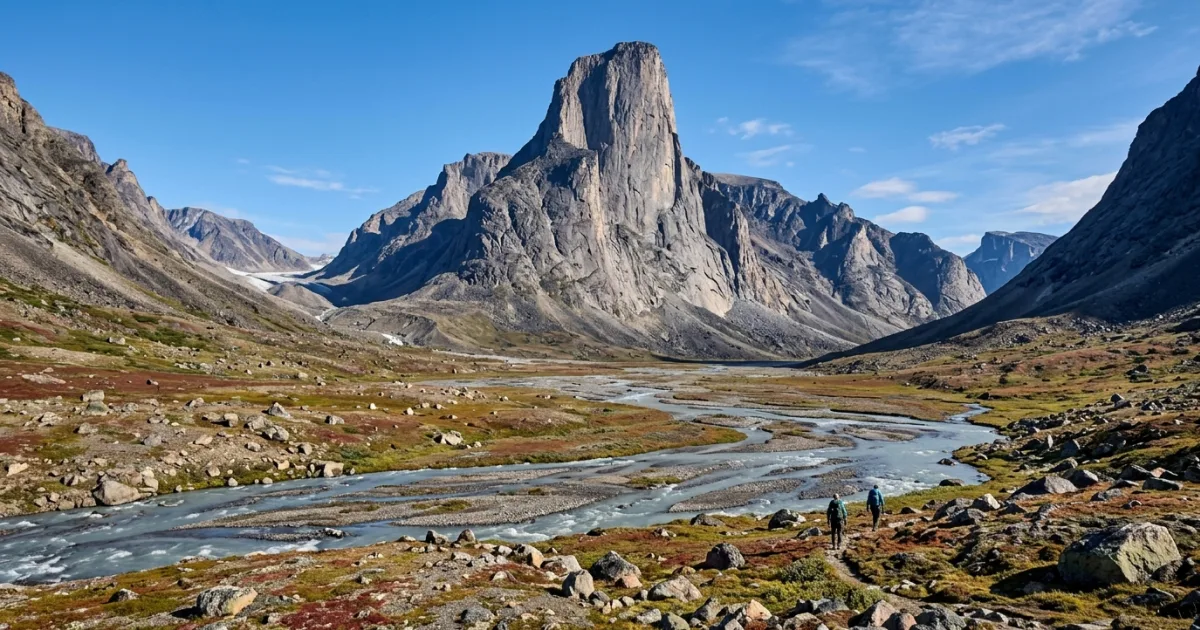
The park is accessed primarily through two remote Inuit hamlets: Pangnirtung in the south and Qikiqtarjuaq in the north. Between these settlements cuts the Akshayuk Pass, an ancient glacial melt corridor that serves as the park's primary trekking corridor. Traveling here entails true expedition-level commitment. Visitors must navigate moraines of loose talus, boulder-strewn glacial outwash plains, and surging braided rivers fed by melting ice fields, all while carrying all sustenance, shelter, and emergency gear without cell coverage or emergency services nearby.
Reasons to Visit
- Gaze upon Mount Thor, featuring the world's greatest purely vertical cliff drop of 1,250 meters at an average angle of 105 degrees.
- Trek the legendary Akshayuk Pass, an ancient 97-kilometer glacial valley corridor slicing through jagged Arctic peaks.
- Marvel at Mount Asgard's iconic twin cylindrical granite towers, immortalized in the opening ski jump sequence of the James Bond film 'The Spy Who Loved Me'.
- Experience true 24-hour Arctic daylight under the midnight sun throughout the short summer months of July and August.
- Encounter Arctic wildlife including Arctic foxes, rock ptarmigan, lemmings, and occasional polar bears roaming glacial moraines.
Things to Avoid
- Never attempt to cross glacial rivers without unfastening your backpack hip belt and sternum strap; if you slip, an attached pack can submerge you in freezing water.
- Avoid crossing glacial rivers in the afternoon or evening when rising solar radiation dramatically increases meltwater volume and current strength.
- Do not camp near delta flood plains or dry riverbeds, as sudden glacial outburst floods (jökulhlaups) can inundate low ground within minutes.
- Avoid leaving food or scented toiletries inside sleeping tents; use bear-resistant containers positioned at least 100 meters downwind from sleeping shelters.
- Do not underestimate the Arctic wind; avoid pitching lightweight three-season tents that can collapse or tear in violent valley gusts.
Local Transportation Tips
Within Auyuittuq National Park, zero roads, boardwalks, or mechanized transport methods exist; travel is strictly by foot during summer or ski/snowmobile during guided spring expeditions. Access to the park boundaries requires boat charter services operated by local Inuit outfitters in Pangnirtung or Qikiqtarjuaq. During summer, boats navigate 30 kilometers up the fiord to the Overlord warden station or North Pangnirtung Fiord. In winter and spring, local guides transport visitors across frozen sea ice via traditional wooden qamutiik sleds pulled by snowmobiles.
Travel Etiquette
- Respect Inuit cultural heritage and traditional harvest rights; leave ancient stone markers, fox traps, and meat caches (inuksuit) undisturbed.
- Adhere to strict Leave No Trace principles: pack out all human waste, food scraps, and used personal care products from the backcountry.
- Request permission before photographing local Inuit residents, drying fish, or carving artists in the gateway hamlets of Pangnirtung and Qikiqtarjuaq.
- Attend the mandatory Parks Canada briefing attentively, demonstrating respect for the local staff and the environmental regulations designed to safeguard the delicate tundra.
Recommended Age Group
Due to frigid conditions, treacherous river crossings, and total lack of emergency rescue infrastructure, Auyuittuq National Park is suited almost exclusively for seasoned adults with proven wilderness experience.
- Babies (0-2 years): Not Recommended. Extreme Arctic weather, sub-zero hypothermia dangers, polar bear risks, and multi-day evacuation times make this environment entirely unsafe for infants.
- Kids (3-12 years): Not Recommended. High-volume glacial river crossings, endless talus fields, and heavy pack-carrying requirements present severe physical safety hazards for young children.
- Teens (13-19 years): Neutral. Older, highly athletic teenagers with extensive backcountry wilderness backpacking and mountaineering experience may participate under competent adult supervision.
- Adults (20-64 years): Recommended. Fit, self-reliant adults possessing mountain hiking, route-finding, and cold-weather survival skills will find Auyuittuq to be a world-class wilderness destination.
- Seniors (65+ years): Neutral. Highly fit seniors with multi-day expedition experience can complete routes, but loose boulder fields and powerful currents pose elevated fracture risks.
Accessibility Level: Medium
- Auyuittuq National Park is an extreme backcountry wilderness area and does not offer wheelchair-accessible trails, boardwalks, or paved pathways.
- Gateway visitor centers in Pangnirtung and Qikiqtarjuaq provide level-entry access, interpretive museum displays, and accessible orientation classrooms.
- Physical travel within the park demands strenuous unassisted walking over loose moraine boulders, deep sand, and rocky riverbeds without bridges.
- Emergency medical evacuation relies on satellite alerts and chartered helicopter dispatch from Iqaluit, which can be grounded for days during Arctic storms.
Did You Know?
Mount Thor's 1,250-meter vertical drop is so steep that if an object were dropped from the cliff edge, it would fall unimpeded for roughly 20 seconds before hitting the valley floor below. Furthermore, the iconic parachute ski jump performed by stuntman Rick Sylvester in the 1977 James Bond film 'The Spy Who Loved Me' was filmed on Mount Asgard inside the park.
Cool Statistics
- 1,250 meters: Height of Mount Thor's sheer vertical face, the steepest vertical drop on Earth.
- 19,089 square kilometers: Total protected polar wilderness area of Auyuittuq National Park.
- 6,000 square kilometers: Size of the Penny Ice Cap, a surviving fragment of the ancient Laurentide Ice Sheet.
- 97 kilometers: Length of the complete Akshayuk Pass traverse connecting North and South Pangnirtung fiords.
- 0: Permanent roads, utility lines, or cellular towers inside the park boundaries.






Buy a compatible power adapter for your trip