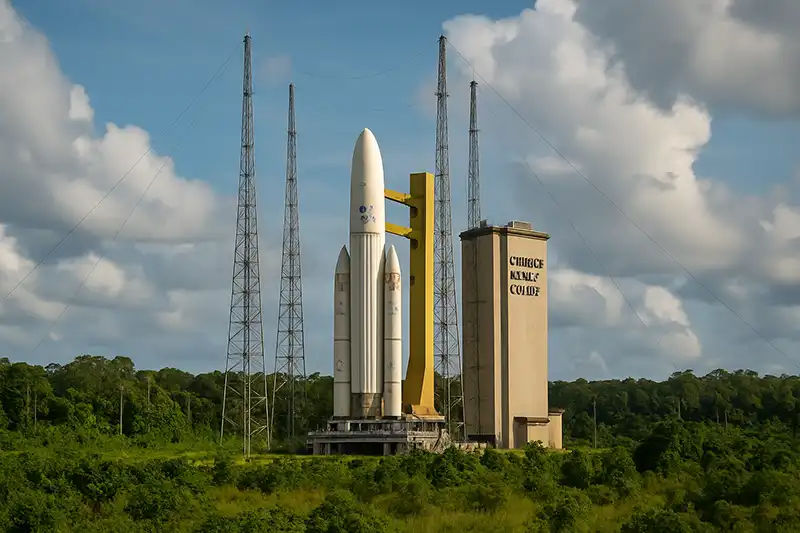
French Guiana occupies 83,534 square kilometers on the northeastern coast of South America, bordered by Brazil to the east and south, and Suriname to the west. The territory operates as an overseas department and region of France, utilizing the Euro as its official currency and adhering to European Union standards. The Guiana Space Centre, established in 1964 near Kourou, launches satellites for the European Space Agency, Arianespace, and the French space agency (CNES). The population of approximately 300,000 is concentrated along the coastal plain, leaving the interior Amazonian rainforest largely untouched and accessible only by river or air. The climate is equatorial, characterized by high humidity and an average annual temperature of 27°C (80°F).
Reasons to Visit
- The Guiana Space Centre offers free, guided tours of its launch facilities and a comprehensive space museum.
- The Îles du Salut (Salvation Islands) preserve the haunting ruins of the infamous Devil's Island penal colony, operating from 1852 to 1953.
- The Amazon Rainforest covers nearly 99% of the territory, providing unparalleled opportunities for eco-tourism and wildlife spotting.
- Camp de la Transportation in Saint-Laurent-du-Maroni serves as a historical monument detailing the processing of French convicts.
- The Kaw-Roura Nature Reserve spans 94,700 hectares of wetlands, hosting significant populations of black caimans and diverse bird species.
Things to Avoid
- Avoid swimming in rivers or coastal waters without local guidance due to strong currents, muddy conditions, and the presence of caimans or piranhas.
- Do not venture into the deep jungle without a certified guide, as the terrain is unforgiving and GPS signals are unreliable.
- Avoid illegal gold mining areas (garimpos) in the interior, which are associated with violent crime and environmental degradation.
- Refrain from drinking tap water outside of major towns like Cayenne and Kourou to prevent waterborne illnesses.
- Do not travel without comprehensive travel insurance that covers medical evacuation, as specialized healthcare facilities are limited.
Local Transportation Tips
Transportation in French Guiana relies heavily on a limited road network, primarily the Route Nationale 1 (RN1) connecting Cayenne, Kourou, and Saint-Laurent-du-Maroni. Public buses and shared minivans (taxicos) operate between major coastal towns, offering affordable but infrequent service. Car rentals are available at Cayenne-Félix Eboué Airport and are highly recommended for exploring the coastal region independently. Inland travel requires motorized pirogues (dugout canoes) navigating the Maroni and Oyapock rivers, or domestic flights operated by Air Guyane Express to remote communes like Maripasoula and Saül.
Travel Etiquette
- Greet shopkeepers and locals with a polite 'Bonjour' before asking questions or initiating a transaction.
- Dress modestly when visiting indigenous or Maroon villages, respecting local customs and asking permission before taking photographs.
- Tipping is not mandatory as a 15% service charge is typically included in restaurant bills, but leaving small change is appreciated for exceptional service.
- Carry physical identification (passport or national ID) at all times, as French military and police frequently conduct checkpoints.
- Respect the strict environmental regulations in nature reserves by packing out all trash and maintaining a safe distance from wildlife.
Recommended Age Group
French Guiana offers a unique blend of space technology and raw jungle environments, making it best suited for older, adventurous travelers.
- Babies (0-2 years): Not Recommended. High humidity, mosquito-borne diseases, and a lack of infrastructure in the interior make it unsuitable for infants.
- Kids (3-12 years): Neutral. While the Space Centre is educational, long boat rides and intense jungle conditions can be physically challenging for young children.
- Teens (13-19 years): Recommended. Jungle trekking, space history, and wildlife spotting offer highly engaging and educational experiences for teenagers.
- Adults (20-64 years): Recommended. The destination is ideal for eco-tourism, historical exploration, and adventure travel, requiring a moderate level of physical fitness.
- Seniors (65+ years): Neutral. Coastal areas and guided tours are accessible, but extreme heat and rugged terrain in the interior pose physical challenges.
Accessibility Level: Medium
- Wheelchair accessibility is generally limited to major hotels, modern museums, and the Guiana Space Centre in Kourou.
- Sidewalks in Cayenne and Saint-Laurent-du-Maroni are often uneven or non-existent, making mobility challenging.
- Nature reserves and jungle lodges typically lack paved paths and accessible facilities.
- Boat tours to the Îles du Salut require navigating steep steps and uneven docks, which may be difficult for travelers with limited mobility.
- Public transportation is not equipped with ramps or lifts; private taxis or specialized rental vehicles are necessary.
Did You Know?
French Guiana is the only territory on the mainland of the Americas that is fully integrated into a European country. The territory's longest border is shared with Brazil, making it the longest land border France shares with any nation. The European Space Agency's launch site in Kourou is strategically located just 500 kilometers north of the equator, providing rockets with an extra velocity boost from the Earth's rotation.
Cool Statistics
- 98.9% of French Guiana's land area is covered by dense Amazonian rainforest.
- The territory spans 83,534 square kilometers, making it the largest French region by land area.
- The Guiana Space Centre accounts for approximately 15% of the territory's direct and indirect employment.
- Over 700 species of birds and 177 species of mammals inhabit the diverse ecosystems of French Guiana.
- The Guiana Amazonian Park covers 33,900 square kilometers, representing one of the largest national parks in the European Union.






Buy a compatible power adapter for your trip