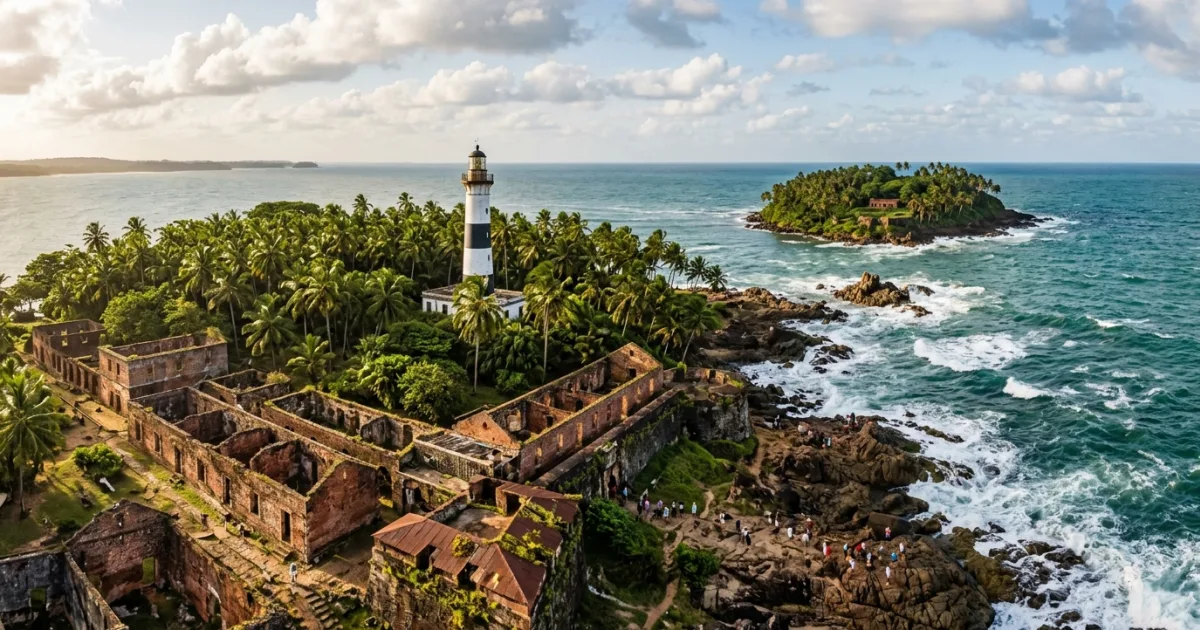
The Îles du Salut (Salvation Islands) comprise three volcanic islets positioned 11 kilometers off the shore of French Guiana in South America. Named during the 1760s when mainland settlers fled yellow fever outbreaks to find safety in the offshore sea breezes, the archipelago underwent a dramatic transformation in 1852 when Napoleon III established a harsh penal settlement across the islands. For a century, thousands of convicts experienced extreme carceral confinement inside the stone compounds of Île Royale and the solitary confinement cells of Île Saint-Joseph, while political prisoners were banished to the windswept isolation of Île du Diable.
Following the definitive decommission of the penal colony in 1953, nature steadily reclaimed the brick structures, iron gates, and stone walkways. Today, Île Royale functions as the primary hub for travelers, featuring a small heritage museum, walking loops through tropical gardens, and panoramic terraces facing Devil's Island. Controlled by France's space agency (CNES), the archipelago also houses telemetry monitoring equipment tracking Ariane and Vega space launches heading into orbit over the Atlantic.
Reasons to Visit
- Explore the haunting, tree-strangled ruins of nineteenth-century French penal architecture on Île Royale and Île Saint-Joseph.
- Encounter abundant wildlife including fearless agoutis, green sea turtles feeding off the wharf, and mischievous capuchin monkeys.
- Observe the inaccessible cliffs and former stone cottage of Captain Alfred Dreyfus across the channel on Île du Diable.
- Experience a pristine, traffic-free tropical sanctuary surrounded by cobalt Atlantic ocean panoramas.
- Discover the historic lighthouse, chapel, and restored director's quarters that chronicle centuries of French overseas history.
Things to Avoid
- Avoid swimming anywhere along the exposed rocky coasts; offshore currents and rip tides are life-threatening.
- Do not try to feed or touch the resident monkeys and agoutis, as wild animals can bite or carry parasites.
- Avoid planning your trip without checking the Guiana Space Centre launch schedule, which forces mandatory closures of the islands.
- Do not wander off marked trails into decaying masonry structures where ceiling stones and roof tiles may collapse.
Local Transportation Tips
Transportation around the Îles du Salut is strictly pedestrian; no private motor vehicles exist on any of the islands. Paved and dirt footpaths circle Île Royale (approximately 3 kilometers around) and Île Saint-Joseph. Inter-island transit between Île Royale and Île Saint-Joseph is handled by local small shuttle launches running several scheduled transfers daily, subject to weather conditions and tide levels.
Travel Etiquette
- Respect the somber memory of the penal colony by not vandalizing ruins or removing bricks, artifacts, or historic hardware.
- Carry all non-biodegradable waste back to mainland Kourou to preserve the fragile island ecosystem.
- Dress modestly when entering the historic chapel and museum facilities on Île Royale.
- Ensure you adhere strictly to departure boarding times for catamarans returning to Kourou.
Recommended Age Group
Visiting the Îles du Salut requires traveling across open ocean waters and walking extensively on uneven, unpaved terrain among historic ruins.
- Babies (0-2 years): Not Recommended. The open sea catamaran crossing can be turbulent, and steep, unpaved trails are ill-suited for strollers.
- Kids (3-12 years): Neutral. Children interested in wildlife and boats will enjoy seeing monkeys and turtles, though parents must maintain strict vigilance near unfenced cliffs and hazardous waters.
- Teens (13-19 years): Recommended. High engagement potential with history, photography, outdoor hiking, and wildlife encounters.
- Adults (20-64 years): Recommended. Ideal demographic for absorbing the historical context, hiking coastal loops, and enjoying scenic photography.
- Seniors (65+ years): Recommended. Well-suited for active seniors comfortable with walking moderate distances on slight inclines and boarding boats via floating pontoons.
Accessibility Level: Medium
- The primary jetty on Île Royale features a floating pontoon, but swell movements can make wheelchair transfers from catamarans challenging.
- Main access roads ascending from the dock to the upper plateau on Île Royale have steep gradients and uneven cobblestone paving.
- Historic cellblocks, prison hospitals, and cemetery areas lack ramps, elevators, and paved barrier-free walkways.
- Auberge des Îles has ground-floor dining access, but public restrooms and lodging options feature steps and narrow doorways.
Did You Know?
Henri Charrière immortalized Devil's Island in his bestselling novel Papillon, alleging an escape using sacks of coconuts as a raft, although historical records indicate he was actually imprisoned on the Guianese mainland and Île Saint-Joseph rather than on Devil's Island itself.
Cool Statistics
- Total land area of the three islands: 0.62 square kilometers (153 acres).
- Distance from mainland French Guiana: 11 kilometers (6.8 miles) north of Kourou.
- Total number of prisoners transported through the penal colony system: over 70,000 men.
- Maximum elevation: 66 meters (217 feet) atop Île Royale.






Buy a compatible power adapter for your trip