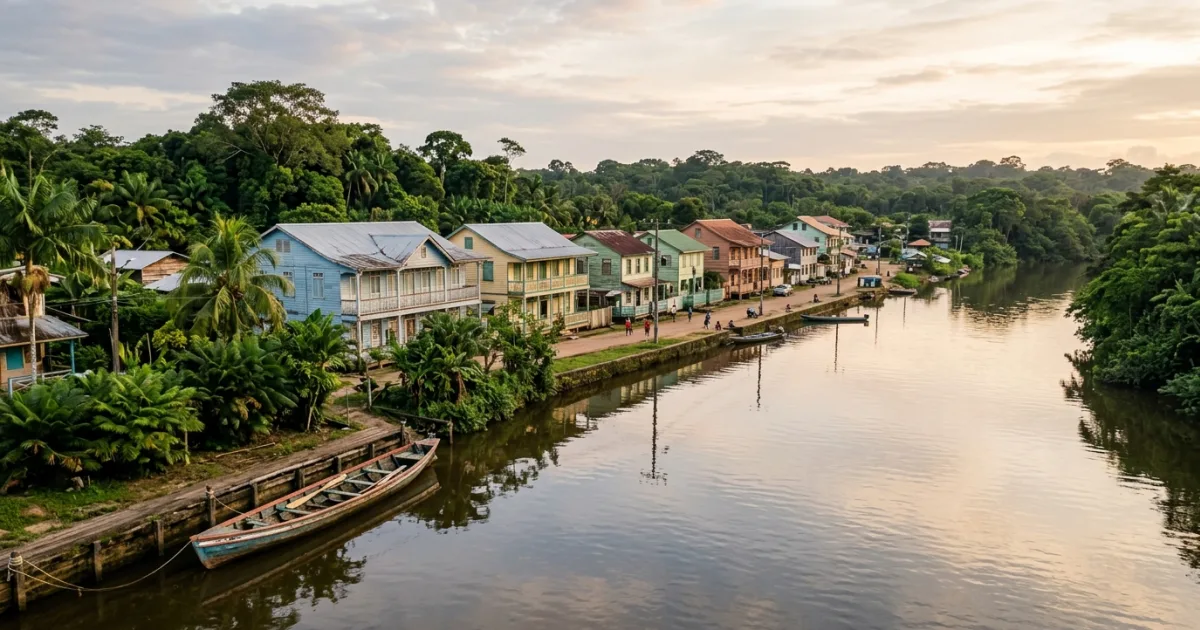
Mana stands out in French Guiana as a rare architectural and cultural gem, preserved along the quiet banks of the Mana River. Founded in 1828 by Blessed Anne-Marie Javouhey, Superior of the Sisters of Saint Joseph of Cluny, the town served as a visionary agricultural colony that successfully educated and integrated freed slaves decades before full abolition. The layout of the town still reflects this intentional design, with its historic wooden church, convent buildings, and orderly rows of colonial-era timber homes painted in soft pastels.
Today, Mana functions as the administrative and cultural anchor of northwestern French Guiana, bridging the dense Amazonian forest and the Atlantic shoreline. Its population brings together Kali'na Amerindians, Bushinengue communities, and Creole families, creating an exceptional living tapestry of traditions. It is also the gateway to the Réserve Naturelle Nationale de l'Amana, one of the most critical marine turtle nesting grounds on Earth, making Mana a cornerstone destination for conscious eco-tourists and history lovers alike.
Reasons to Visit
- Authentic colonial wooden architecture, centered around the historic Église Saint-Joseph de Mana.
- Immediate gateway access to the massive Amana Nature Reserve and the sea turtle beaches of Awala-Yalimapo.
- Rich cultural convergence showcasing traditional Kali'na basketry, pottery, and Maroon wood carving.
- Tranquil riverfront excursions by pirogue along the Mana River into virgin Amazonian riparian forests.
- Unhurried, low-density tourism that provides an authentic view of everyday life in western French Guiana.
Things to Avoid
- Do not shine white flashlight beams or use camera flashes on beaches during turtle nesting season; use strictly red-filtered illumination.
- Avoid traveling into remote coastal and forest tracks without checking seasonal road conditions, especially during the heavy wet season.
- Do not expect widespread English fluency; keeping basic French phrases or a translation tool ready is vital.
- Avoid touching or collecting historical artifacts or undisturbed flora within national nature reserve perimeters.
Local Transportation Tips
Personal vehicle hire is the most effective and reliable way to explore Mana and the surrounding district. Rental cars are readily available at Cayenne Félix Eboué Airport or in nearby Saint-Laurent-du-Maroni (roughly 45 minutes away by car). Within the town of Mana itself, distances are compact and easily traversed on foot or by bicycle. Collective shared taxis (taxis collectifs) operate along the main RN1 corridor connecting to Saint-Laurent-du-Maroni, though their departure times are variable. For exploring adjacent rivers and tributaries, motorized traditional wooden boats (pirogues) operated by certified local guides are standard.
Travel Etiquette
- Always greet shopkeepers and locals with a polite 'Bonjour' before asking questions or starting transactions.
- Request permission explicitly before taking photographs of Amerindian artisans, village elders, or their private homes.
- Respect spiritual and natural sites by maintaining low noise levels and removing all personal trash.
- Dress modestly when visiting ecclesiastical buildings and traditional community settlements.
Recommended Age Group
Mana provides an educational and nature-focused environment that best accommodates independent adults, nature enthusiasts, and families with self-sufficient children.
- Babies (0-2 years): Not Recommended. Tropical humidity, intense sun, insect activity, and remote medical services present logistical hurdles for infant care.
- Kids (3-12 years): Neutral. Children interested in wildlife will marvel at marine turtles, though long car transfers and quiet natural walks require patience.
- Teens (13-19 years): Recommended. Excellent destination for teenagers enthusiastic about outdoor adventure, biology, photography, and off-grid exploration.
- Adults (20-64 years): Recommended. Perfect for travelers seeking profound history, untamed nature, authentic cultural dialogue, and peaceful eco-lodging.
- Seniors (65+ years): Neutral. Highly enjoyable for active seniors interested in heritage and birding, provided they are comfortable with tropical heat and uneven natural footpaths.
Accessibility Level: Medium
- Town streets in central Mana are predominantly flat, but modern paved sidewalks with dropped curbs are limited.
- Historical colonial timber buildings and rural church entrances frequently require climbing exterior wooden steps.
- Beach excursions and nature reserve boardwalks at Awala-Yalimapo feature deep sand and unpaved dirt terrain that is inaccessible to standard wheelchairs.
- Accessible vehicle rentals and specialized transport services are scarce in the western region of French Guiana.
Did You Know?
Sister Anne-Marie Javouhey, who founded Mana in 1828, managed an experimental colony that successfully emancipated and educated hundreds of enslaved individuals several years before France's final 1848 decree of abolition, earning her enduring historical respect across French Guiana.
Cool Statistics
- Home to one of the largest nesting populations of Leatherback sea turtles (Dermochelys coriacea) in the Atlantic basin.
- The Amana Nature Reserve spans approximately 14,800 hectares of protected wetlands, mangroves, and coastal dunes.
- Mana's historic town center contains dozens of protected wooden heritage structures dating back to the 19th century.






Buy a compatible power adapter for your trip