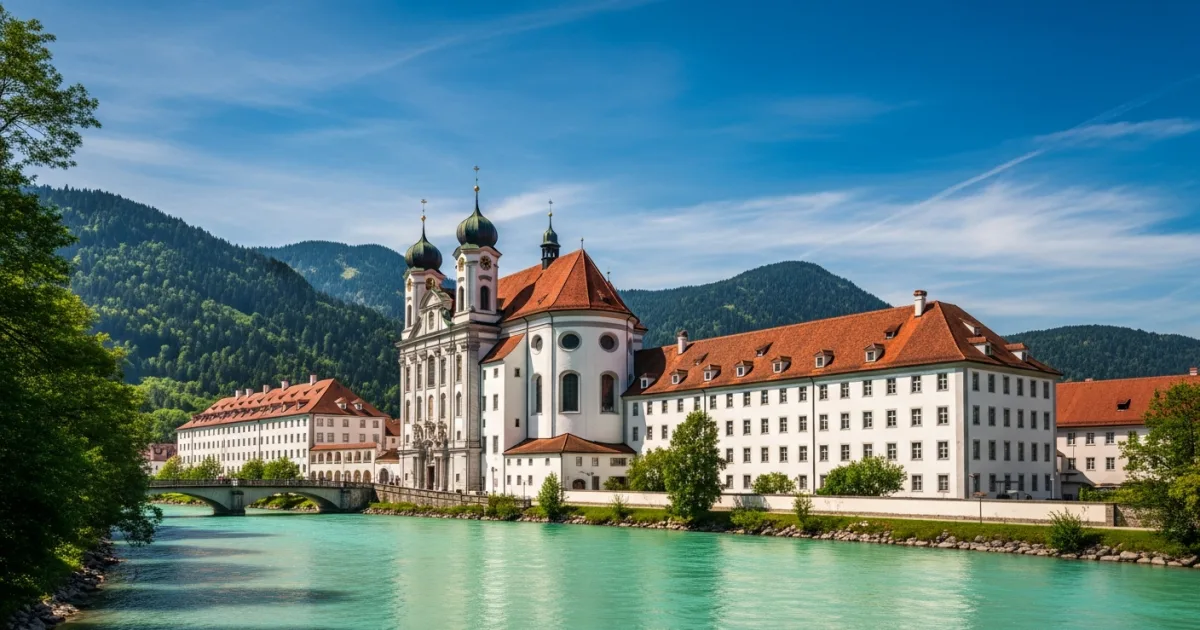
St Mang Abbey stands as a testament to the rich spiritual and cultural history of the Allgäu region. Founded in the 9th century by the Irish-Gallican monk Magnus, the site evolved over centuries into a powerful Benedictine monastery. The current architectural masterpiece is a result of a massive Baroque reconstruction initiated in the late 17th century by local architect Johann Jakob Herkomer. Herkomer's vision transformed the medieval complex into a symmetrical, Italian-inspired Baroque marvel. Today, the south wing of the abbey houses the Museum of Füssen, which offers visitors a comprehensive look at the town's history. One of the most significant exhibits is the collection of historical lutes and violins, highlighting Füssen's status as the cradle of commercial lute making in Europe. The museum also grants access to the abbey's most stunning rooms, including the lavishly frescoed Imperial Hall (Kaisersaal) and the intricately designed library.
Reasons to Visit
- Admire the breathtaking Baroque architecture and the stunning frescoes of the Imperial Hall.
- Discover the fascinating history of European lute and violin making in the Museum of Füssen.
- View the oldest preserved fresco in Bavaria, dating back to the year 980, located in the abbey's crypt.
- Experience a quieter, deeply historical attraction away from the massive crowds of nearby Neuschwanstein Castle.
Things to Avoid
- Avoid visiting on Mondays during the off-season, as the museum may have restricted hours or be closed.
- Do not touch the historical instruments or artifacts on display, as they are highly fragile.
- Avoid rushing through the crypt; take your time to appreciate the ancient frescoes and the solemn atmosphere.
Local Transportation Tips
St Mang Abbey is centrally located in the Altstadt (Old Town) of Füssen and is best explored on foot. The town itself is highly walkable, with many pedestrian-only zones. If you are arriving by train, the Füssen train station is only a 5 to 10-minute walk from the abbey. For those traveling from nearby castles or villages, local buses frequently stop at the central bus station adjacent to the train station. Bicycles are also a popular mode of transport in the region, with numerous rental shops available nearby.
Travel Etiquette
- Maintain a quiet and respectful demeanor, as the abbey is a site of historical and religious significance.
- Greet shopkeepers and museum staff with a polite 'Guten Tag' (Good day) when entering.
- When dining in nearby traditional Bavarian taverns, it is customary to round up the bill or leave a 5-10% tip for good service.
Recommended Age Group
St Mang Abbey offers a serene and educational experience that appeals to a variety of age groups, particularly those with an interest in history, art, and music.
- Babies (0-2 years): Neutral. While babies are welcome, the quiet museum environment and the presence of stairs in some historical sections may make navigating with a stroller challenging.
- Kids (3-12 years): Recommended. Children can be fascinated by the old musical instruments and the grand, colorful frescoes, though the quiet nature of the museum requires parental supervision.
- Teens (13-19 years): Recommended. Teens with an interest in history, architecture, or music will find the lute-making exhibits and the Baroque design highly engaging.
- Adults (20-64 years): Recommended. Adults will fully appreciate the deep cultural heritage, the detailed craftsmanship of the instruments, and the architectural beauty of the Imperial Hall.
- Seniors (65+ years): Recommended. The museum is generally accessible with an elevator for the main floors, allowing seniors to enjoy the exhibits at a comfortable, leisurely pace.
Accessibility Level: Medium
- The Museum of Füssen is equipped with an elevator, providing wheelchair access to the main exhibition floors.
- Some historical areas, such as the ancient crypt, involve stairs and uneven surfaces, which may not be fully accessible to visitors with limited mobility.
- Accessible restrooms are available within the museum complex.
- Seating areas are strategically placed throughout the galleries for visitors who need to rest.
Did You Know?
Did you know that Füssen was the first city in Europe to establish a guild for lute makers? In 1562, the town's instrument makers formed a guild, setting strict quality standards and cementing Füssen's reputation as a premier center for musical instrument craftsmanship across the continent.
Cool Statistics
- The abbey's crypt houses a Reichenau school fresco from the year 980, making it the oldest in Bavaria.
- The Baroque reconstruction of the abbey took nearly 30 years, spanning from 1697 to 1726.
- Füssen's lute makers' guild, established in 1562, was the first of its kind in Europe.
- The Imperial Hall features magnificent ceiling frescoes painted by the renowned artist Franz Georg Hermann.







Buy a compatible power adapter for your trip