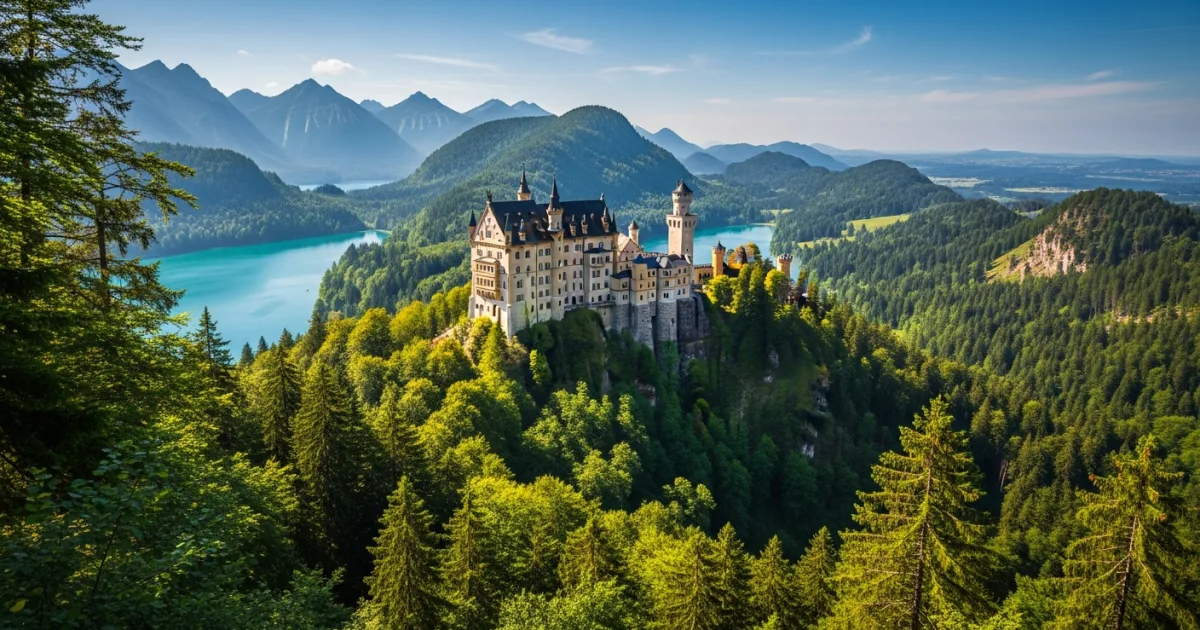
Hohenschwangau Castle stands as a testament to the romanticism of the 19th century. Originally a ruined fortress dating back to the 12th century, it was discovered by Crown Prince Maximilian of Bavaria (later King Maximilian II) during a hiking trip in 1829. Captivated by the stunning scenery, he purchased the ruins and commissioned the reconstruction of the castle in a neo-Gothic style. The project was completed in 1837, resulting in the vibrant yellow palace that graces the landscape today.
The castle served as the official summer residence and hunting lodge for Maximilian, his wife Marie of Prussia, and their two sons, Ludwig and Otto. It was within these walls that the young Ludwig II spent his formative years, surrounded by murals depicting the legends of the Swan Knight, Lohengrin, and other Germanic sagas. These romanticized depictions deeply influenced Ludwig, ultimately inspiring him to build his own fairy-tale masterpiece, Neuschwanstein Castle, just across the valley.
Reasons to Visit
- Experience the authentic, lived-in childhood home of King Ludwig II, offering more historical context than Neuschwanstein.
- Admire over 90 stunning interior wall paintings depicting Germanic myths and Bavarian history.
- Enjoy breathtaking, less-crowded views of the Alpsee lake and the surrounding Alpine peaks.
- See the original Biedermeier furniture and historical artifacts belonging to the Bavarian royal family.
- Explore the beautiful castle gardens, including the iconic Swan Fountain.
Things to Avoid
- Avoid arriving without pre-booked tickets during the summer months, as they frequently sell out.
- Do not attempt to take photos inside the castle; the rule is strictly enforced by tour guides.
- Avoid wearing uncomfortable shoes, as the walk from the ticket center to the castle involves a steep incline.
- Don't rush your visit; allocate time to walk around the scenic Alpsee lake located just below the castle.
Local Transportation Tips
The village of Hohenschwangau is easily accessible from the nearby town of Füssen via local buses (lines 73 and 78), which drop you off near the Ticket Center. From the Ticket Center, Hohenschwangau Castle is accessed via a moderate 20 to 30-minute uphill walk. Alternatively, visitors can pay for a horse-drawn carriage ride that takes you most of the way up, though a short walk is still required at the end. Unlike Neuschwanstein, there is no motorized shuttle bus service to Hohenschwangau Castle.
Travel Etiquette
- Arrive at the castle courtyard at least 15 minutes before your scheduled tour time; latecomers are not admitted.
- Backpacks, large bags, and strollers are not allowed inside the castle and must be left at the designated storage areas.
- Maintain a quiet and respectful demeanor during the guided tour so all guests can hear the guide.
- Respect the natural environment by staying on marked trails and disposing of trash properly.
Recommended Age Group
Hohenschwangau Castle offers a captivating historical experience, but the logistics of the visit vary in suitability across different age groups.
- Babies (0-2 years): Neutral. Strollers are not permitted inside the castle, and there are numerous stairs to navigate during the tour. Parents must carry infants in a front carrier.
- Kids (3-12 years): Recommended. The fairy-tale appearance of the castle, the knightly murals, and the horse-drawn carriage rides make it an engaging experience for children.
- Teens (13-19 years): Recommended. Teens will appreciate the dramatic history of King Ludwig II and the excellent photography opportunities around the castle exterior and the Alpsee.
- Adults (20-64 years): Recommended. Adults will fully grasp the rich historical context, the architectural details, and the romanticism of the 19th-century Bavarian monarchy.
- Seniors (65+ years): Recommended. While the uphill walk can be strenuous, the horse-drawn carriage mitigates much of the effort. However, seniors should be aware that the interior tour involves climbing several flights of stairs without elevator access.
Accessibility Level: Medium
- The interior of Hohenschwangau Castle is not wheelchair accessible due to multiple flights of historical stairs and the absence of an elevator.
- Visitors with limited mobility can take the horse-drawn carriage up the hill, but must still walk a short, steep distance to the entrance.
- Accessible restrooms are available at the Ticket Center in the village below.
- Visually impaired visitors can request to touch certain architectural elements, though this must be arranged in advance.
- Audio guides are available in multiple languages for those who prefer or require them over a live speaking guide.
Did You Know?
Did you know that the famous composer Richard Wagner was a frequent guest at Hohenschwangau? King Ludwig II was a massive patron of Wagner's work, and the composer would often play the square piano that still sits in the Hohenstaufen Room today.
Cool Statistics
- Year completed: 1837 (reconstruction by King Maximilian II).
- Number of wall paintings inside: Over 90.
- Elevation: Approximately 860 meters (2,820 feet) above sea level.
- Annual visitors: Over 300,000 people visit Hohenschwangau each year.







Buy a compatible power adapter for your trip