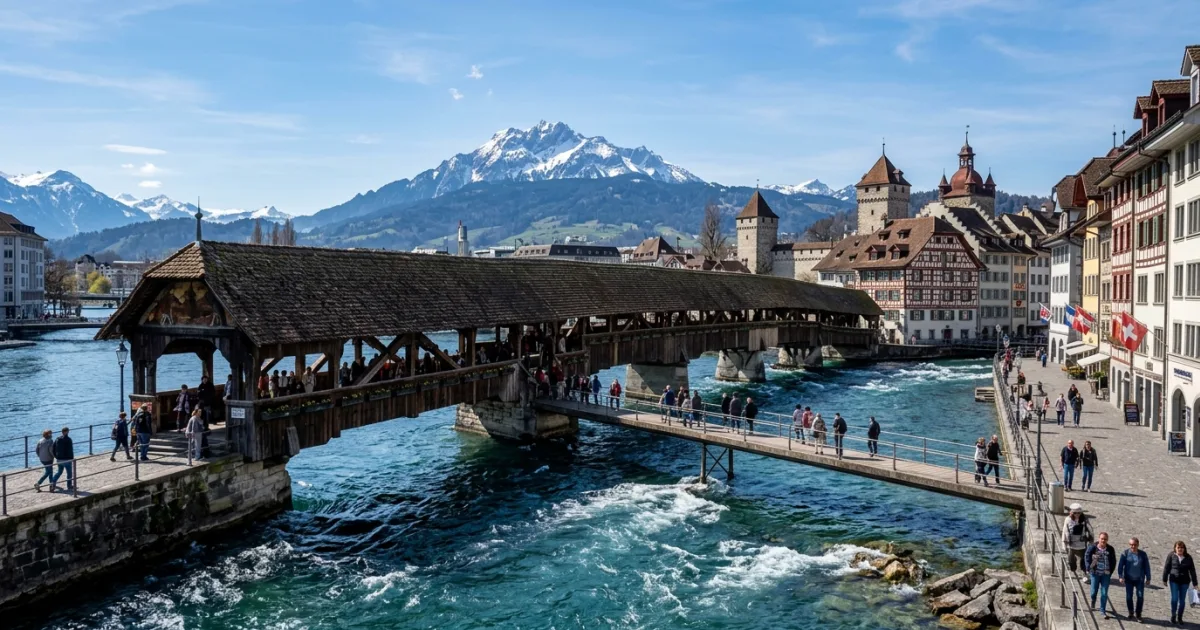
The Spreuer Bridge (Spreuerbrücke) was completed in 1408 as part of Lucerne's city fortifications. Its unique name comes from the German word 'Spreu', meaning chaff. In medieval times, this was the only bridge in the city where residents were legally allowed to dump their wheat chaff and dead leaves into the Reuss River, as it was located furthest downstream, preventing the debris from floating through the town.
Between 1626 and 1635, the bridge was adorned with a series of triangular panel paintings created by Kaspar Meglinger and his workshop. Known as the 'Dance of Death' (Danse Macabre), these 67 surviving panels illustrate that death is the great equalizer, coming for popes, emperors, monks, and peasants alike. Just steps away from the bridge, visitors can also observe the historic needle dam, a fascinating 19th-century engineering marvel still used to regulate the water level of Lake Lucerne.
Reasons to Visit
- View the largest known 'Dance of Death' painting cycle in the world.
- Experience authentic medieval Swiss architecture and engineering.
- Enjoy stunning, unobstructed views of the Reuss River and Lucerne's Old Town.
- It is a completely free attraction that is open 24/7.
- It is generally less crowded than the nearby Chapel Bridge, allowing for a more peaceful experience.
Things to Avoid
- Avoid touching the historic paintings, as the oils from your skin can damage the centuries-old artwork.
- Do not ride bicycles or e-scooters across the bridge; it is strictly for pedestrians.
- Avoid blocking the narrow walkway while taking photographs, as locals use the bridge for daily commuting.
Local Transportation Tips
The Spreuer Bridge is easily accessible on foot from anywhere in central Lucerne. It is approximately a 10-minute walk from the Lucerne Central Train Station (Luzern Bahnhof). Simply follow the Reuss River downstream past the Chapel Bridge. The city's excellent public bus network also has stops nearby, such as the 'Kasernenplatz' stop, which is just a two-minute walk from the bridge entrance.
Travel Etiquette
- Keep to the right side of the bridge while walking to allow for smooth two-way pedestrian traffic.
- Maintain a respectful volume, as the bridge is a historical monument and a daily thoroughfare for locals.
- Do not leave any trash or throw anything into the river below.
Recommended Age Group
The Spreuer Bridge is a versatile attraction that appeals to visitors of all ages, offering a mix of history, art, and scenic views.
- Babies (0-2 years): Recommended. The bridge is flat and accessible for strollers, making it an easy walk for parents.
- Kids (3-12 years): Recommended. Children will enjoy looking at the rushing water and the unique wooden structure, though the dark themes of the paintings might require some gentle explanation.
- Teens (13-19 years): Recommended. The slightly macabre 'Dance of Death' paintings often appeal to teenagers, and the bridge offers excellent photo opportunities.
- Adults (20-64 years): Recommended. Adults will appreciate the deep historical context, the artistry of the panels, and the romantic atmosphere of the Old Town.
- Seniors (65+ years): Recommended. The bridge is flat, well-maintained, and provides a leisurely, barrier-free walking experience with benches nearby to rest.
Accessibility Level: Medium
- The bridge is fully accessible to wheelchair users and those with limited mobility, featuring flat wooden planks and ramped access points.
- There are no steps required to cross the bridge.
- Handrails are present along the entire length of the bridge.
- Lighting is adequate during the evening, though the interior can be slightly dim to protect the paintings.
Did You Know?
Did you know that the 'Dance of Death' paintings were commissioned shortly after a devastating plague epidemic? The artwork was intended to serve as a 'memento mori'—a reminder of human mortality—urging citizens to live pious lives because death could strike anyone at any moment.
Cool Statistics
- Year built: 1408.
- Number of original paintings: 71 (67 survive today).
- Artist of the paintings: Kaspar Meglinger.
- The bridge was partially destroyed by a flood in 1566 and subsequently rebuilt.
- A small chapel dedicated to the Virgin Mary was added to the middle of the bridge in 1568.







Buy a compatible power adapter for your trip