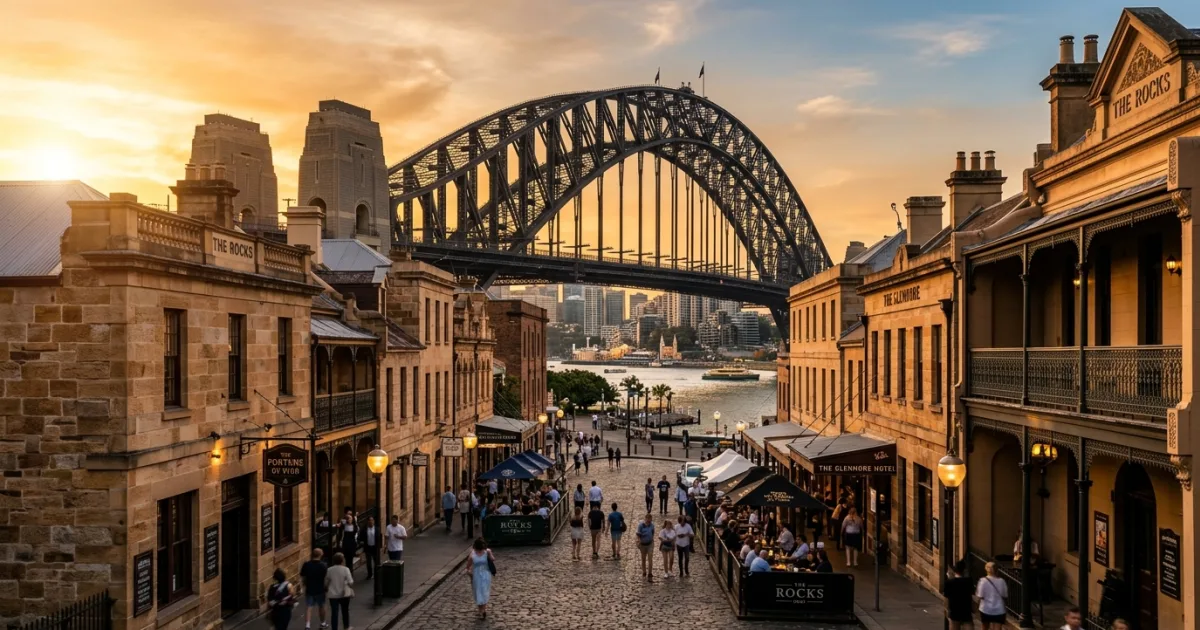
The Rocks occupies an iconic position on the western fringe of Sydney Cove, where the First Fleet dropped anchor in January 1788 to establish a British convict settlement. Sandstone was carved directly from the shoreline's cliffs to construct storehouses, cottages, and defensive fortifications, giving the precinct its enduring name. Throughout the 19th century, the neighborhood gained notoriety as a gritty enclave of whalers, convicts, sailors, and larrikin push gangs, centered around drinking dens and the infamous Argyle Cut, a manual excavation pushed through solid rock by convict labor.
Today, following fierce community preservation campaigns in the 1970s that halted blanket commercial redevelopment, The Rocks stands as an intricately preserved living museum. Seamlessly interwoven into Sydney's modern financial center, its leafy courtyards, gas-lamp styled streets, and heritage brick warehouses host independent microbreweries, upscale restaurants, indigenous art galleries, and the world-renowned Museum of Contemporary Art Australia. Visitors can effortlessly transition from uncovering colonial archaeological ruins beneath the Big Dig center to admiring unobstructed views of the Sydney Opera House from waterfront promenades.
Reasons to Visit
- Unmatched colonial heritage: Explore Australia's densest concentration of surviving 18th- and 19th-century sandstone architecture and convict-built structures.
- Historic craft pubs: Savor craft ales inside establishments like the Lord Nelson Brewery Hotel, the Fortune of War, and the Hero of Waterloo, rich with centuries of maritime folklore.
- Vibrant weekend markets: Shop directly from local Australian artisans, jewelers, printmakers, and culinary vendors along bustling George and Playfair Streets.
- Breathtaking harbour vantage points: Enjoy postcard-perfect perspectives of the Sydney Opera House and access the scenic pedestrian crossing on the Sydney Harbour Bridge.
- Cutting-edge contemporary culture: Visit the Museum of Contemporary Art Australia (MCA) to view groundbreaking Australian, international, and Indigenous artwork along the waterfront.
Things to Avoid
- Do not wear high heels or slick-soled footwear: Navigating the damp, sloping cobblestones and uneven historic sandstone stairs requires supportive flat shoes with strong traction.
- Avoid relying solely on GPS mapping: Multi-tiered streets, elevated walkways, and tunnel cuts can confuse smartphone navigation; look for physical heritage signposts.
- Do not pay full price for bridge views prematurely: Before booking commercial observation decks, walk the free public pedestrian footpath across the Sydney Harbour Bridge.
- Avoid booking airport cabs during rush hours: Morning and evening gridlock around Sydney CBD makes the direct T8 train line from Circular Quay significantly faster and more reliable.
Local Transportation Tips
The Rocks is exceptionally well-connected through Sydney's Circular Quay transport interchange, located immediately adjacent to the district. Commuters and travelers can access suburban rail services via the T2, T3, and T8 train lines, catch harbour ferries departing from Circular Quay wharves toward Manly or Watsons Bay, or board the Sydney Light Rail (L2 and L3 lines) running south along George Street. Sydney's public transport utilizes contactless payment via bank cards or reloadable Opal cards, featuring daily travel fee caps across the network.
Travel Etiquette
- Service tipping is discretionary: Australian hospitality workers are paid award wages; tipping 5-10% is customary only for exceptional table service at fine dining restaurants.
- Respect heritage structures: Sandstone blocks in The Rocks are soft and prone to erosion; avoid carving, leaning heavy bikes against historic walls, or climbing restricted structures.
- Queue patiently at bars and food stalls: Stand back until acknowledged by bartenders and maintain orderly lines at weekend market kiosks.
- Keep left on stairs and bridge walkways: Always stay on the left-hand side when walking across the Sydney Harbour Bridge pedestrian path or climbing heritage staircases.
Recommended Age Group
The Rocks accommodates a wide spectrum of travelers, though physical accessibility across historic levels must be weighed for very young children and individuals with reduced mobility.
- Babies (0-2 years): Neutral. The lower waterside promenades around Circular Quay are smooth and flat for strollers, but the elevated heritage alleys and steep sandstone stairways present substantial physical hurdles.
- Kids (3-12 years): Neutral. Children enjoy the vibrant weekend street entertainers, open foreshore parks, and interactive history displays at The Rocks Discovery Museum, though the abundance of adult-oriented historic pubs and boutique shops can limit interest.
- Teens (13-19 years): Recommended. Highly engaging ghost walking tours after dark, immediate access to the Sydney Harbour Bridge, street food vendors, and modern art exhibits keep teenagers thoroughly intrigued.
- Adults (20-64 years): Recommended. An optimal destination offering world-class dining, craft microbreweries, rooftop cocktail lounges with harbour vistas, and diverse cultural museums within compact, walkable streets.
- Seniors (65+ years): Recommended. Rich colonial history, well-curated heritage collections, leisurely flat harbour strolls, and convenient public transport make it deeply rewarding, provided historic stairs are bypassed via flatter street paths.
Accessibility Level: Medium
- Surface terrain: Major thoroughfares such as George Street and Circular Quay West feature wide, smooth paved sidewalks with dropped kerbs, whereas internal alleyways (e.g., Suez Canal, Kendall Lane) feature historic uneven cobblestones.
- Vertical transit: Public outdoor elevators operate near Circular Quay and underneath the Sydney Harbour Bridge approaches, allowing travelers with mobility devices to bypass select steep stairs.
- Museum access: The Museum of Contemporary Art Australia and The Rocks Discovery Museum are equipped with wheelchair-accessible entrances, automated doors, and accessible public restrooms.
- Public transit access: Circular Quay train station, ferry wharves, and the light rail terminus provide ramped, step-free access with audible boarding announcements.
Did You Know?
In the 1970s, The Rocks was slated for complete demolition under an urban renewal plan that would have replaced the historic sandstone village with concrete high-rise office towers. The neighborhood was saved by an unprecedented alliance of local residents and the Builders Labourers Federation (BLF), who enacted famous 'Green Bans'—refusing to demolish or construct anything on the site until the government agreed to protect Sydney's colonial heritage.
Cool Statistics
- 1788: The year British settlement was established in The Rocks, forming modern Sydney.
- 1843: The completion year of the Argyle Cut, carved through solid sandstone using convict pickaxes.
- Over 100: The number of registered heritage buildings, warehouses, and ruins preserved across the precinct.
- 200+: Artisan stalls operating throughout George and Playfair Streets during weekly market events.






Buy a compatible power adapter for your trip